

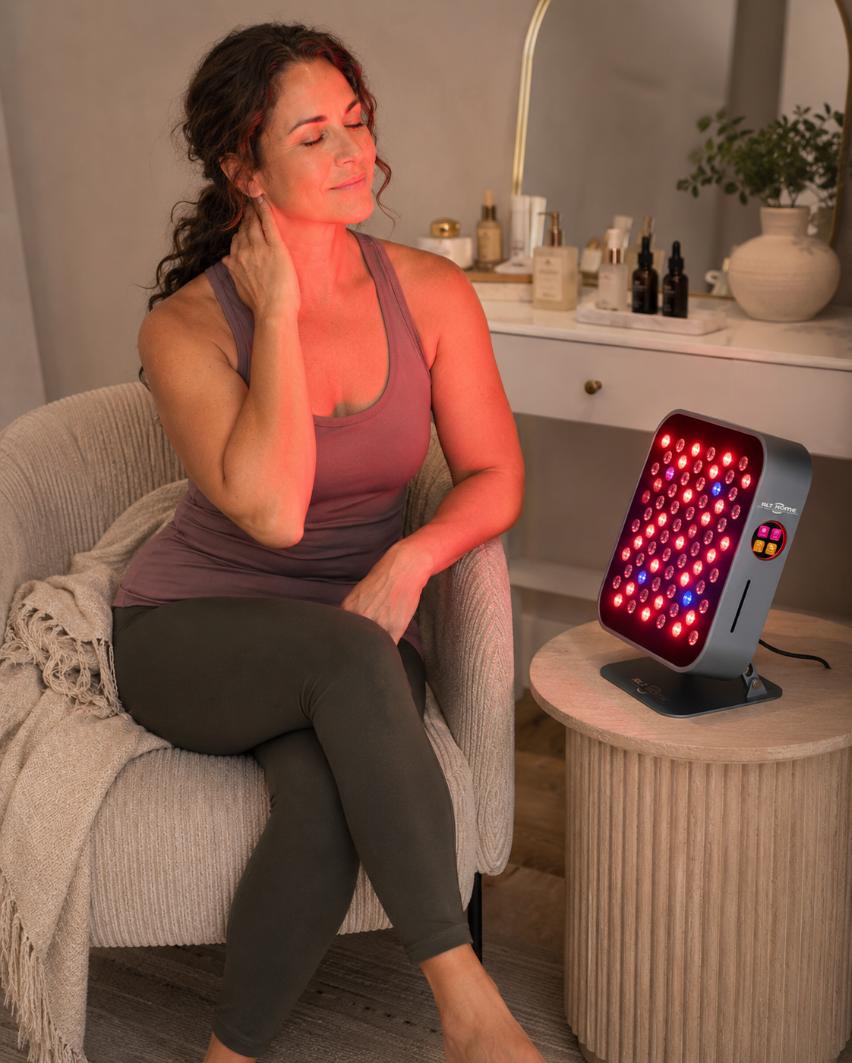
BlockBlueLight is the Australian family-owned brand best known for its blue-light blocking glasses and a seven-wavelength PowerPanel red light therapy line. RLT Home, the newer challenger, ships a similarly broad seven-wavelength spectrum from its Total Spectrum series, with study-tuned density, motorized stands included on the full-body models, and a free personalised usage plan written by the science team for every customer.
This is one of the closer comparisons in the category. Both brands publish all seven wavelengths. Both include deep infrared. Both back their devices with multi-year warranties. The differences are real but they sit in the details: LED chip construction, warranty length, trial structure, what comes in the box, and whether a personalised protocol arrives with the panel.
This comparison cuts through the marketing and examines what matters in practice. Spectrum and wavelength density. Measured irradiance. LED chip design. Panel size and body coverage. Treatment modes. Included accessories. Return policies. Warranty coverage. Pricing transparency.
The verdict at the end comes from the data, not the hype.
At-a-glance verdict: RLT Home wins on three points that change real-world outcomes. First, deeper-penetration spectrum tuning: RLT Home allocates 33 percent of every panel to the deepest-penetrating bands (810nm + 1064nm) versus BlockBlueLight’s 23 percent at the equivalent bands (810nm + 1060nm), and 14 percent to deep-infrared 1064nm versus BlockBlueLight’s 9 percent at 1060nm. Second, a multi-beam lens system (15° / 30° / 60°) that concentrates output onto the body, against BlockBlueLight’s flat 60° beam angle that scatters a meaningful share of the panel’s output to the walls and floor. Third, a free personalised weekly usage plan written by the science team for every customer, plus a 60-day no-restocking trial with free insured return shipping. BlockBlueLight retains a credible edge on its 5-year warranty (two years longer than RLT Home’s 3-year) and on its honest dual-disclosure of both solar-meter and spectrometer irradiance figures.
💡 Our Top Pick
After comparing both brands head-to-head on spectrum density, measured irradiance, included accessories, trial terms, warranty, and pricing transparency, our team found the RLT Home Total Spectrum Ultra to be the better overall choice for buyers who want a true single-panel full-body setup with seven wavelengths including 1064nm deep penetration, an included motorized electric stand, a 60-day no-restocking trial, and a free personalised weekly usage plan from the science team.
Best Red Light Therapy Panels of 2026 (BlockBlueLight vs RLT Home)
- Best Overall: RLT Home Total Spectrum Ultra
- Best for Deep Tissue (1064nm): RLT Home Total Spectrum Elite
- Best Long Warranty: BlockBlueLight PowerPanel MEGA (5-year warranty)
- Best Budget Premium Panel: BlockBlueLight PowerPanel MID at $699.95
- Best Compact Panel: RLT Home Total Spectrum Compact
Current Deals on Both Brands
Now is a great time to invest in a red light therapy panel while saving money. Both brands are running active offers.
- RLT Home: 6% off site-wide with code TOP10 (applied at checkout)
- BlockBlueLight: check the site for current promotions; family-owned Australian brand with US warehouse
Quick Comparison Table: BlockBlueLight vs RLT Home Flagships
| Tier | RLT Home | BlockBlueLight |
|---|---|---|
| Mid-size single panel | Total Spectrum Max 360 single-chip 5W LEDs 7 wavelengths (480-1064nm) 100.5 mW/cm² spectrometer peak Stand and free insured shipping included 3-year warranty, 60-day trial, no restocking fee $1,795 (~$1,687 with TOP10) |
PowerPanel MAX 240 dual-chip 5W LEDs 7 wavelengths (590-1060nm) 87 mW/cm² spectrometer average / 167 mW/cm² solar meter Stand sold separately ($132-$370) 5-year warranty, 30-day return $1,099.95 panel only |
| Full-body lie-under | Total Spectrum Ultra 480 single-chip 5W LEDs 7 wavelengths including 1064nm 64.3 inch tall × 11.8 inch wide single panel 119.3 mW/cm² spectrometer peak Motorized electric stand included 3-year warranty, 60-day trial, no restocking fee $2,895 (~$2,721 with TOP10) |
PowerPanel MEGA 300 dual-chip 5W LEDs (1500W panel) 7 wavelengths (590-1060nm) 87 mW/cm² spectrometer average / 167 mW/cm² solar meter Stand sold separately ($132-$370) 5-year warranty, 30-day return $1,499.95 panel only (~$1,632 with floor stand) |
| Largest full-body | Total Spectrum Elite 864 single-chip 5W LEDs 7 wavelengths including 1064nm 65 inch tall × 20.5 inch wide single panel 121.6 mW/cm² spectrometer peak Motorized electric stand included 3-year warranty, 60-day trial, no restocking fee $4,595 (~$4,319 with TOP10) |
ULTIMATE XXL 1200 dual-chip 5W LEDs 7 wavelengths (590-1060nm) Largest BBL single panel Stand sold separately ($132-$370) 5-year warranty, 30-day return $4,499.95 panel only (~$4,632 with floor stand) |
At a Glance: BlockBlueLight vs RLT Home (2026)
| Criterion | BlockBlueLight | RLT Home |
|---|---|---|
| Devices in lineup | Target Torch (handheld), PowerPanel Portable, PowerPanel Mini, TABLETOP, MID, PRO, MAX, MEGA, ELITE XL, ULTIMATE XXL (plus Face Mask and SAD Light Panel) | Total Spectrum Mini, Compact, Max, Ultra, Elite (single-chip, 7 wavelengths every model) |
| Wavelengths | 7 on PowerPanel models (590nm, 630nm, 660nm, 810nm, 830nm, 850nm, 1060nm). Includes the 1060nm deep-infrared band. | 7 on every model (480, 630, 660, 810, 830, 850, 1064nm). 1064nm deep-infrared on every Total Spectrum device. |
| Per-wavelength density published | Yes (on the MEGA spec sheet): 590nm 16%, 630nm 17%, 660nm 17%, 810nm 14%, 830nm 14%, 850nm 13%, 1060nm 9%. About 50% of the panel allocation goes to red/amber surface bands. The deepest-penetration band (1060nm) gets only 9%. | Yes, deliberately tuned to clinical-study targets: 480nm 6%, 630nm 19%, 660nm 19%, 810nm 19%, 830nm 14%, 850nm 9%, 1064nm 14%. About 56% reaches NIR or deeper; 33% targets the deepest-penetrating 810nm + 1064nm bands specifically. |
| Deepest wavelength | 1060nm across the PowerPanel line. | 1064nm on every Total Spectrum device. |
| LED chip type | 5W LED packages with dual-chip construction (two wavelength dies share each 5W package). | 5W LED packages, single-chip (one wavelength die uses the full 5W). Supports higher per-band peak and enables the study-tuned density weighting above. |
| Irradiance | 167 mW/cm² solar meter at 6 inches, 87 mW/cm² spectrometer average at the same distance. BlockBlueLight is one of the more honest competitors in publishing both figures side-by-side. | 98.7 to 121.6 mW/cm² across the line, spectrometer peak at 6 inches, published per device. Spectrometer peak is not directly comparable to spectrometer average; both brands report real measurements but use different reference points. |
| Stand | Sold separately. Base Stand $131.95, Portable Stand $39.95, Deluxe Floor Stand with wheels $154.95, Horizontal Stand $369.95, Wall Mount Bracket $79.95. | Included on every Total Spectrum panel. Motorized electric stand included on Ultra and Elite at no extra cost. No restocking fee. |
| Treatment modes | Continuous and pulsed light modes; controlled via on-panel buttons. | 9 prebuilt condition modes built from the Vladimir Heiskanen photobiomodulation database (1,861 human trials with successful results) plus a custom mode. |
| Personalised usage plan | None. Online buying guides and customer support resources. | Free custom weekly plan from the science team for every customer (mode, distance, body position, duration, weekly frequency). |
| Eye protection in box | Sold separately ($19.95 for the BlockBlueLight Red Light Therapy Eye Protection Glasses). | 2 sets included (reading glasses + blackout goggles). |
| Trial | 30-day return policy. | 60 days, no restocking fee, free insured return shipping. |
| Warranty | 5 years on PowerPanel models. Longer than the 3-year industry norm and a genuine BlockBlueLight win. | 3 years. |
| Internet / app | None. On-panel controls only. | None, devices stay offline (for those seeking privacy). |
| FDA compliance | FDA-registered (same listing as RLT Home). BlockBlueLight does not market the panels as “medical-grade” the way some US competitors do. | FDA-registered (same listing as BlockBlueLight). |
| Single-panel full-body coverage | The ULTIMATE XXL is the largest BlockBlueLight single panel. The MEGA and ELITE XL are also full-body class. Stand sold separately for lie-under setup. | Yes, Total Spectrum Ultra (64 inches tall × 11.8 inches wide) and Total Spectrum Elite (65 inches × 20.5 inches), single-panel designs with motorized stand included. |
| Country of manufacture | Australian family-owned brand. US warehouse for fast US shipping. Panels manufactured overseas. | International manufacturing, CE and RoHS certified, FDA-registered. |
The Brands at a Glance
BlockBlueLight: Family-Owned Australian Brand With 7-Wavelength PowerPanel Line

BlockBlueLight is an Australian family-owned brand that built its reputation around blue-light blocking glasses and added the seven-wavelength PowerPanel red light therapy line as the category matured. The lineup spans the handheld Target Torch through the ULTIMATE XXL flagship, with PowerPanel MID, PRO, MAX, MEGA, and ELITE XL filling the middle tiers.
The full PowerPanel spectrum includes 590nm (amber), 630nm and 660nm (red), 810nm, 830nm, and 850nm (near infrared), and 1060nm (deep infrared). That is a wider spectrum than most competitors and very close to RLT Home’s seven-wavelength layout. The notable difference: BlockBlueLight uses 590nm amber while RLT Home uses 480nm blue at the short end.
BlockBlueLight also publishes its per-band density on the PowerPanel MEGA spec sheet: 590nm 16%, 630nm 17%, 660nm 17%, 810nm 14%, 830nm 14%, 850nm 13%, 1060nm 9%. That puts roughly half (50 percent) of the panel into red and amber surface bands, with the deepest-penetration 1060nm band getting 9 percent of total allocation. The next section compares this against RLT Home’s deliberately deeper-tuned weighting.
The PowerPanel line uses dual-chip 5W LEDs, where two wavelength dies share each 5W LED package. Beam angle is a flat 60 degrees across the entire lineup, which is wider than ideal for keeping the panel’s output on the body rather than scattering into the surrounding room.
BlockBlueLight is one of the more honest competitors in the category on irradiance reporting. The MEGA product page lists both the solar-meter figure (167 mW/cm² at 6 inches) and the spectrometer-verified average (87 mW/cm² at the same distance). Many premium competitors only publish the higher solar-meter number; BlockBlueLight publishes both side-by-side.
The 5-year warranty is significantly longer than the 3-year industry norm and is the brand’s clearest competitive win. The 30-day return policy is shorter than RLT Home’s 60-day trial. Stands and eye protection are sold separately.
RLT Home: Newer, Transparent, Support-Led
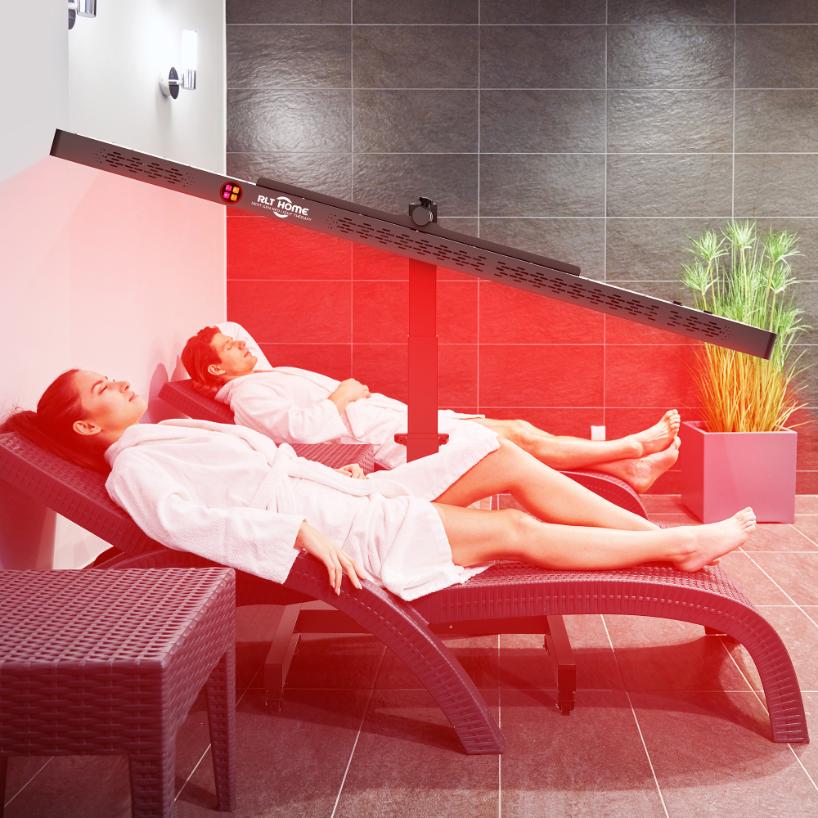
RLT Home’s Total Spectrum series spans five vertical and full-body panels, from the 72-LED Mini to the 864-LED Elite. The brand publishes the exact percentage of LEDs allocated to each of its seven wavelengths, with deliberate weighting toward the bands that reach deeper tissue.
This includes 14 percent at 1064nm deep infrared, the deepest-penetrating band of the lot, and 19 percent at 810nm near infrared. A co-founder explains the spectrum on a YouTube video showing the underlying clinical-study analysis used to engineer each treatment mode.
Notably for buyers, RLT Home includes a free personalised weekly usage plan. After purchase, the customer receives a follow-up from the founder, shares their target conditions, and the RLT Home science team writes a custom plan describing which mode to run, for how long, and how often. No other panel brand we have compared offers this.
Spectrum and Wavelength Density: Where Both Brands Compete

Both brands list seven wavelengths and both include a deep-infrared band. This is the closest spectrum parity we have seen across the comparisons we have run. The differences sit in three places: which short-end wavelength each brand chose, how output is distributed across the seven bands, and what LED construction each brand uses.
RLT Home Publishes Exact Wavelength Allocation, Tuned to the Science
| Wavelength | Density | Role |
|---|---|---|
| 480nm (blue) | 6% | Surface, skin-targeting, acne |
| 630nm (red) | 19% | Surface skin, collagen |
| 660nm (red) | 19% | Surface skin, collagen, hair |
| 810nm (near infrared) | 19% | Muscle, joint, brain |
| 830nm (near infrared) | 14% | Muscle, joint, brain |
| 850nm (near infrared) | 9% | Recovery, fat metabolism |
| 1064nm (deep infrared) | 14% | Joints, deep tissue, brain |
Roughly 56 percent of every RLT Home Total Spectrum panel’s output lands in the 810nm-and-deeper bands, including a deliberate 14 percent at the 1064nm deep band.
BlockBlueLight’s Density: Wider Spectrum, But Weighted Toward Surface Bands
BlockBlueLight also publishes its per-band density breakdown on the PowerPanel MEGA spec sheet, which is more transparent than most competitors. Putting both density tables side-by-side makes the design philosophy of each brand visible.
| Wavelength | BlockBlueLight | RLT Home | What it reaches |
|---|---|---|---|
| 480nm (blue) | n/a | 6% | Surface (acne, skin tone) |
| 590nm (amber) | 16% | n/a | Surface only (minimal penetration) |
| 630nm (red) | 17% | 19% | Surface skin, collagen |
| 660nm (red) | 17% | 19% | Surface skin, collagen, hair |
| 810nm (near infrared) | 14% | 19% | Muscle, joint, brain |
| 830nm (near infrared) | 14% | 14% | Muscle, joint, brain |
| 850nm (near infrared) | 13% | 9% | Muscle, joint |
| 1060 / 1064nm (deep infrared) | 9% | 14% | Joints, deep tissue, brain |
| Combined deep-penetration bands (810 + 1060/1064nm) | 23% | 33% | RLT Home allocates roughly 43% more |
BlockBlueLight allocates 50 percent of its panel allocation to red and amber surface bands (590nm + 630nm + 660nm). The deepest-penetration band, 1060nm, gets just 9 percent. RLT Home weights the deepest-penetration bands more heavily: 19 percent at 810nm and 14 percent at 1064nm, for 33 percent of every panel deliberately targeted at the wavelengths most strongly associated in the photobiomodulation literature with muscle, joint, and brain effects. That is roughly 43 percent more output at the deepest-penetrating bands than BlockBlueLight.
BlockBlueLight uses 590nm amber at the short end of the spectrum. Amber light is sometimes associated with surface skin and mood effects but penetrates only the outermost skin layers. RLT Home uses 480nm blue at the short end, which targets skin-surface and acne-causing bacteria. The bigger structural difference is what each brand chose to do with the remaining ~84 percent of allocation: BlockBlueLight tilts toward the visible red/amber half (50% total), RLT Home tilts toward the NIR-and-deeper half (about 56%, including the 33% deep-penetration concentration above).
Edge: RLT Home on density tuning toward deeper-penetrating bands. Both brands publish their density breakdowns, which is more transparency than most competitors offer. The split is in what the allocation was tuned for: BBL has more surface-band output, RLT Home has more deep-tissue output.
Power and Irradiance: Measured by Independent Third Parties
Comparing irradiance across brands is one of the easiest places to be misled. Solar power meters read high and over-report LED output. Spectrometers are the accurate reference, and many third-party reviewers publish averages across measurement spots while brands often publish a single peak number. When comparing two brands, peak-to-peak or average-to-average is the only fair benchmark.
BlockBlueLight’s Published Irradiance
BlockBlueLight publishes both the solar-meter figure (167 mW/cm² at 6 inches on the PowerPanel MEGA) and the spectrometer-verified average (87 mW/cm² at the same distance). Publishing both figures side-by-side is more transparent than the industry norm, where many premium and budget brands publish only the higher solar number. BlockBlueLight is one of the more honest competitors in the category on this dimension.
RLT Home’s Spectrometer-Verified Data
| RLT Home Device | Spectrometer @ 6 inches |
|---|---|
| Total Spectrum Mini | 98.7 mW/cm² |
| Total Spectrum Compact | 99.0 mW/cm² |
| Total Spectrum Max | 100.5 mW/cm² |
| Total Spectrum Ultra | 119.3 mW/cm² |
| Total Spectrum Elite | 121.6 mW/cm² |
RLT Home publishes spectrometer peak figures per device. BlockBlueLight publishes a spectrometer average. Peak and average are not directly comparable without the same measurement protocol, but both brands report real spectrometer-verified data, which is a meaningful step above competitors that only publish solar-meter readings.
Edge: Even on irradiance honesty. Both brands publish real spectrometer data; the measurement reference (peak vs average) differs.
Beam Angle: How Much Light Actually Reaches the Body
Raw irradiance figures only tell half the story. The other half is what percentage of that light actually lands on the user versus scattering into the room. Beam angle controls that.
A 60-degree beam angle means light spreads in a wide cone from each LED. At any usable treatment distance (6 to 18 inches), a meaningful share of that output misses the body entirely and hits the wall, the floor, or the ceiling instead. Narrower beam angles concentrate more output onto the target, which raises the effective dose at the body even if published irradiance figures look similar.
BlockBlueLight’s PowerPanel line uses a single 60-degree beam angle across the entire lineup. This is wider than necessary for most home red light therapy use cases and means a portion of the panel’s output scatters away from the body.
RLT Home’s Total Spectrum Ultra and Elite use a multi-beam lens system that combines 15-degree, 30-degree, and 60-degree angles within the same panel. The 30-degree High-Potency Core delivers concentrated output to the center of the body, the 60-degree Uniform Coverage lenses fill in the edges, and the narrower outer lenses prevent light from spilling sideways into the room. The result is more of the published irradiance actually reaching the user, not the walls.
Edge: RLT Home. Multi-beam lens design means more of the panel’s output reaches the body. BlockBlueLight’s flat 60-degree beam wastes a meaningful share of the panel’s output to the surrounding room, lowering the effective dose at the user even when on-paper irradiance is similar.
LED Chip Design: Single-Chip vs Dual-Chip (Both 5W)
Both brands use 5-watt LED packages. The engineering difference is what is inside each 5W package.
BlockBlueLight uses dual-chip 5W LEDs: two wavelength dies share the 5W power budget inside each LED package. Every spot on the BlockBlueLight panel emits both wavelengths simultaneously, but each band receives roughly 2.5 watts of drive power.
RLT Home uses single-chip 5W LEDs across the entire Total Spectrum series, with the 5W package dedicated to one wavelength die. Different rows of LEDs handle different wavelengths. Each band receives the full 5 watts of drive power, producing higher per-band peak output.
The trade-off shows up in two places. First, single-chip produces a cleaner, higher per-band peak. Second, study-tuned density weighting (such as 19% at 810nm or 14% at 1064nm) is only possible with single-chip construction, because you cannot weight a band to 19 percent if every LED in the panel emits a fixed dual-wavelength split.
Edge: RLT Home for buyers prioritising deep-band peak output and study-tuned density weighting.
Form Factor and Full-Body Coverage
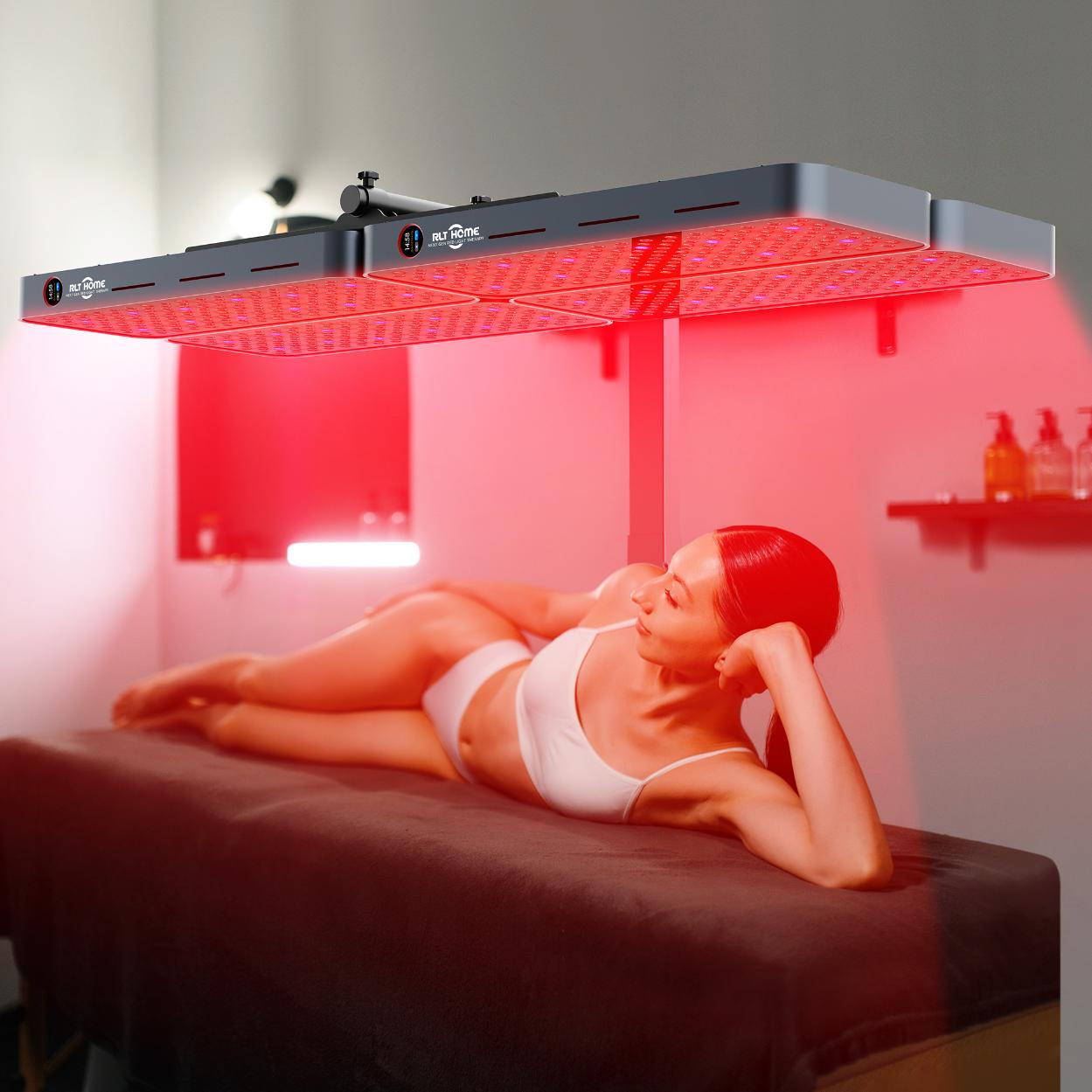

BlockBlueLight’s PowerPanel MEGA, ELITE XL, and ULTIMATE XXL are the brand’s full-body class panels. RLT Home’s Total Spectrum Ultra (64.3 inches tall × 11.8 inches wide) and Total Spectrum Elite (65 inches × 20.5 inches) are designed as single full-body panels.
The notable practical difference is what comes with the panel. RLT Home’s Ultra and Elite ship with an included motorized electric stand that tilts horizontal so users can lie under them. The stand is part of the price, not a separate purchase. BlockBlueLight sells its stands separately, with a Deluxe Floor Stand at $154.95, a Base Stand at $131.95, or the Horizontal Stand at $369.95. Buyers should add the chosen stand’s price to the panel price to compare like-for-like.
Edge: RLT Home on everything-in-the-box convenience for full-body setups, with motorized stand included on Ultra and Elite.
Treatment Modes and Personalised Guidance
BlockBlueLight’s Mode System

BlockBlueLight panels include continuous and pulsed light modes controlled via on-panel buttons. No condition-specific preset programs built from the clinical literature, and no personalised plan is offered after purchase. Customers receive online buying guides and standard support resources.
RLT Home’s Science-Built Modes Plus Free Personalised Plan
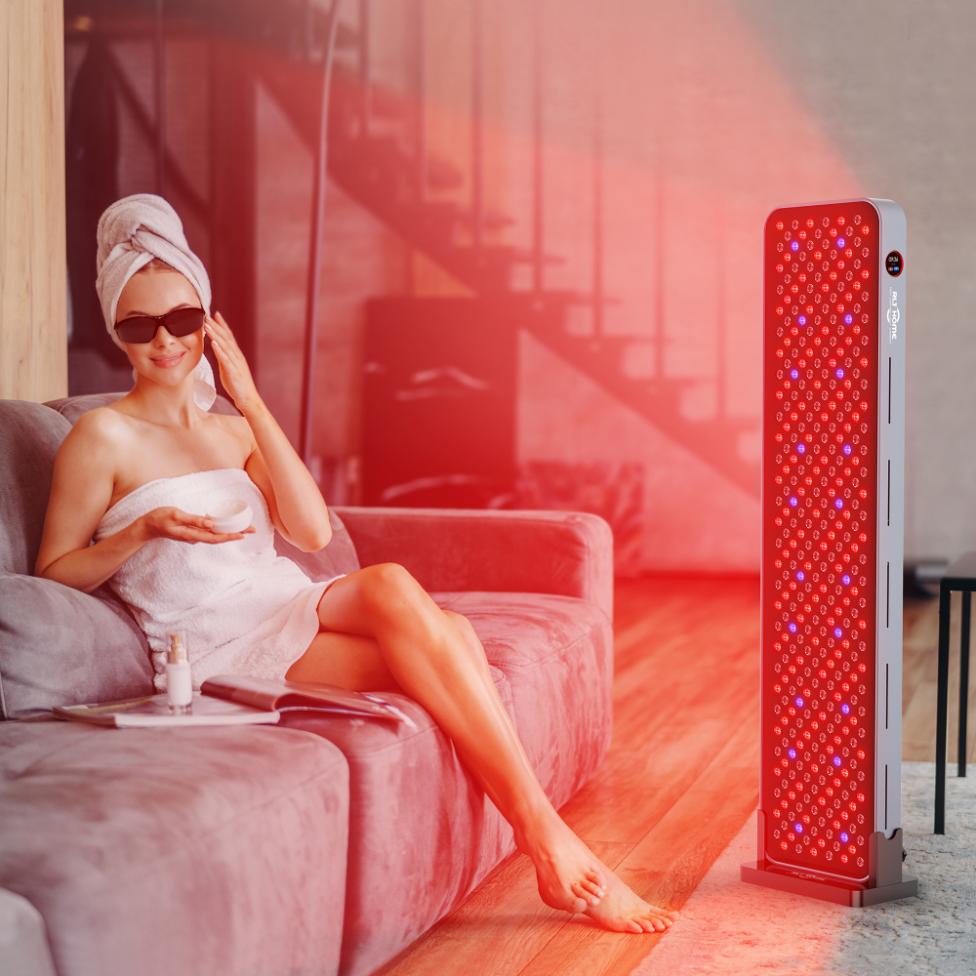
RLT Home’s Total Spectrum series includes nine prebuilt treatment modes plus a custom mode. Each was built by filtering the Vladimir Heiskanen photobiomodulation database (8,980 studies) down to 1,861 human trials with successful results. After purchase, every customer receives a free custom weekly plan written by the science team. No other panel brand we have compared offers this.
Trial, Returns, and Warranty
This is the section where the two brands genuinely split. BlockBlueLight offers a longer warranty; RLT Home offers a longer trial with better return terms.
RLT Home Trial and Warranty Terms
- 60-day trial period
- No restocking fee
- Free insured return shipping
- 3-year warranty coverage
BlockBlueLight Trial and Warranty Terms
- 30-day return policy
- Buyer pays return shipping
- 5-year warranty coverage
Edge: Split. BlockBlueLight’s 5-year warranty is two years longer than RLT Home’s 3-year and is the brand’s strongest competitive win. RLT Home’s 60-day trial with no restocking fee and free insured return shipping is the more buyer-friendly trial structure. Which matters more depends on the buyer: longer warranty for buyers planning to keep the panel for 5+ years, or longer trial with easier returns for buyers who want to try it risk-free.
Privacy and Connectivity
Neither brand connects to the internet or ships a companion app. BlockBlueLight uses on-panel buttons for control. RLT Home’s Total Spectrum devices, by deliberate design, do not connect to the internet and have no companion app. No data leaves the device. For buyers who consider health and usage data sensitive, that is a feature rather than a missing one (for those seeking privacy).
Edge: Even. Both brands stay offline.
FDA Compliance
Every red light therapy panel sold for home use in the United States is FDA-registered. Both BlockBlueLight and RLT Home hold the same FDA-registered status. BlockBlueLight describes its panels accurately as “FDA-registered for additional assurance” rather than using “medical-grade” wording that some US competitors lean on. For buyers who care about precise regulatory language, both brands describe their listing in honest, factual terms.
Pricing: An Apples-to-Apples Comparison
Sticker prices alone do not tell the full story because BlockBlueLight’s panel prices exclude the stand and eye protection, while RLT Home’s panel prices include a stand on every Total Spectrum device. Below is a fair comparison built around equivalent tiers.
Tier 1: Entry / Small Panel
| Item | BlockBlueLight PowerPanel TABLETOP | RLT Home Total Spectrum Mini |
|---|---|---|
| LEDs | 60 dual-chip 5W, 7 wavelengths (590-1060nm) | 72 single-chip, 7 wavelengths (480 to 1064nm) |
| Panel price | $599.95 | $595 (use code TOP10 for an extra 6% off, drops to about $559) |
| Stand | Tabletop format; floor stand sold separately ($132-$155) | Stand included |
| Eye protection | Sold separately ($19.95) | 2 sets included (reading + blackout) |
| Realistic total cost | $599.95 + $19.95 glasses = $619.90 tabletop; add $132 for floor stand if needed | $595 with stand, two sets of eye protection, free insured shipping, no restocking fee. About $559 with code TOP10 |
| Trial / Warranty | 30 days / 5 years | 60 days / 3 years |
Tier 2: Mid-Size Single Panel
| Item | BlockBlueLight PowerPanel MID | RLT Home Total Spectrum Compact |
|---|---|---|
| LEDs | 120 dual-chip 5W, 7 wavelengths | 216 single-chip, 7 wavelengths |
| Panel price | $699.95 | $1,095 (use code TOP10 for an extra 6% off, drops to about $1,029) |
| Stand | Sold separately ($132 base stand or $155 deluxe floor) | Stand included |
| Realistic total cost | $699.95 + $132 base stand = $831.95 (or + $155 deluxe = $854.95) | $1,095 with stand and free insured shipping included, no restocking fee. About $1,029 with code TOP10 |
| Trial / Warranty | 30 days / 5 years | 60 days / 3 years |
Tier 3: Larger Single Panel
| Item | BlockBlueLight PowerPanel MAX | RLT Home Total Spectrum Max |
|---|---|---|
| LEDs | 240 dual-chip 5W, 7 wavelengths | 360 single-chip, 7 wavelengths |
| Panel price | $1,099.95 | $1,795 (use code TOP10 for an extra 6% off, drops to about $1,687) |
| Stand | Sold separately ($132 base or $155 deluxe floor) | Stand included |
| Realistic total cost | $1,099.95 + $132 = $1,231.95 (or + $155 = $1,254.95) | $1,795 with stand and free insured shipping included, no restocking fee. About $1,687 with code TOP10 |
| Trial / Warranty | 30 days / 5 years | 60 days / 3 years |
Tier 4: Full-Body Lie-Under
| Item | BlockBlueLight PowerPanel MEGA | RLT Home Total Spectrum Ultra |
|---|---|---|
| LEDs / Wavelengths | 300 dual-chip 5W, 7 wavelengths including 1060nm. 1500W panel power. | 480 single-chip, 7 wavelengths including 1064nm |
| Panel price | $1,499.95 | $2,895 (with motorized electric stand included; drops to about $2,721 with code TOP10) |
| Stand | Sold separately ($132 base, $155 deluxe floor, or $370 horizontal) | Motorized electric stand included |
| Realistic total cost for lie-under setup | $1,499.95 + $370 horizontal stand = $1,869.95 | $2,895 all-in with motorized stand. About $2,721 with code TOP10 |
| Trial / Warranty | 30 days / 5 years | 60 days / 3 years |
Tier 5: Largest Full-Body Configuration

| Item | BlockBlueLight ULTIMATE XXL | RLT Home Total Spectrum Elite |
|---|---|---|
| LEDs / Wavelengths | 1200 dual-chip 5W, 7 wavelengths including 1060nm. Largest BBL single panel. | 864 single-chip, 7 wavelengths including 1064nm |
| Panel price | $4,499.95 | $4,595 (with motorized electric stand included; drops to about $4,319 with code TOP10) |
| Stand | Sold separately ($132 base, $370 horizontal) | Motorized electric stand included |
| Realistic total cost | $4,499.95 + $370 horizontal stand = $4,869.95 | $4,595 all-in with motorized stand. About $4,319 with code TOP10 |
| Trial / Warranty | 30 days / 5 years | 60 days / 3 years |
At the flagship tier with motorized stand factored in, RLT Home Elite with TOP10 ($4,319) comes in $550 cheaper than BlockBlueLight ULTIMATE XXL with the horizontal stand ($4,870). At the mid tiers, BlockBlueLight is meaningfully cheaper before stand, but the gap narrows once an equivalent stand is added. Buyers who place high value on the 5-year warranty may consider that the deciding factor. Buyers who place high value on the 60-day trial, included motorized stand, and included eye protection may go the other way.
Who Should Choose BlockBlueLight?
Best Fit for Long-Warranty Buyers and Family-Owned Brand Preference
- Value the 5-year warranty as a primary purchase driver (two years longer than the 3-year industry norm)
- Prefer to support a family-owned Australian brand with US warehouse fulfillment
- Comfortable with a 30-day return window and paying return shipping
- Comfortable adding a stand and eye protection separately to the panel purchase
- Value BlockBlueLight’s honest dual-disclosure of solar-meter and spectrometer irradiance figures
- Prefer a more surface-band-weighted spectrum (50 percent in the visible red/amber bands), or want amber 590nm specifically for skin and mood applications
Who Should Choose RLT Home?
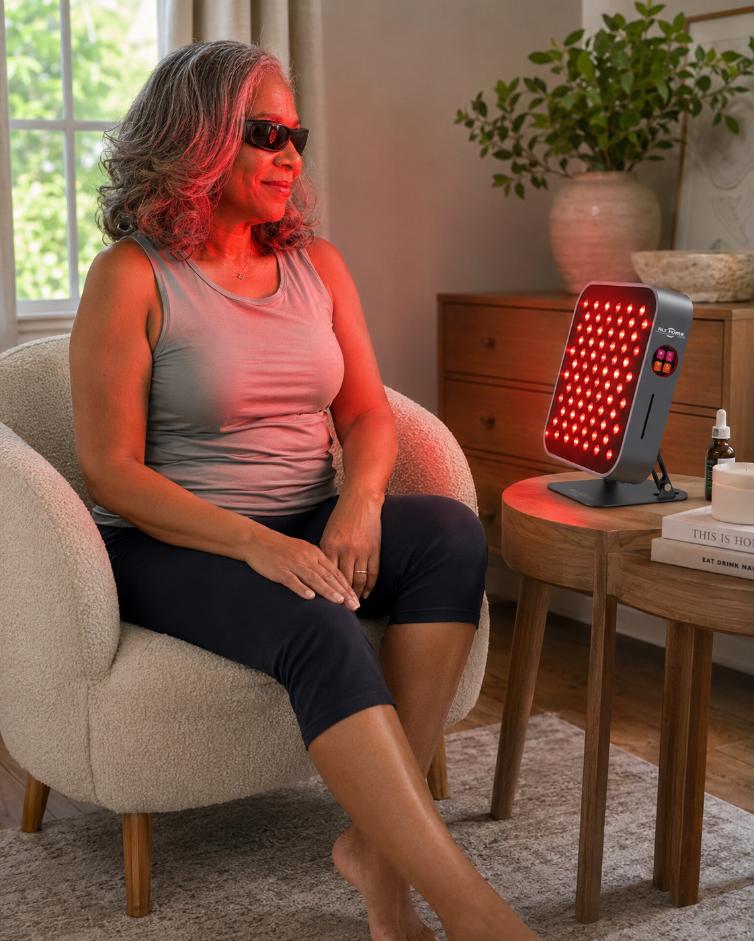
Best Fit for Deep-Wavelength Users and Support Seekers
- Want a spectrum deliberately tuned for deep tissue, joint and brain support: 33 percent of every panel at the deepest-penetration bands (810nm + 1064nm), against BlockBlueLight’s 23 percent at the equivalent bands
- Want the multi-beam lens system (15° / 30° / 60°) that concentrates output onto the body rather than scattering into the room like a flat 60° beam does
- Want a single full-body panel they can lie under, with a motorized stand included
- Value a free personalised weekly usage plan rather than figuring out programming themselves
- Want everything in the box at the purchase price: stand, two kinds of eye protection, free insured shipping
- Want the lowest-risk trial with 60 days, no restocking fee, and free insured return shipping
- Care about privacy with no app and no data tracking
- Prefer single-chip LEDs that drive full per-band peak output rather than splitting wattage across two dies
- Want to apply the TOP10 affiliate code for an extra 6 percent off at checkout
The Verdict: Winner and Runner Up
When the comparison is run on the data, RLT Home takes the overall win, and BlockBlueLight earns a credible runner-up spot, but in different categories. RLT Home takes the broader, transparency-and-support comparison. BlockBlueLight takes the long-warranty niche where its 5-year coverage and family-owned brand reputation genuinely fit.
🏆 Winner, RLT Home: For Most Buyers
Three things separate RLT Home from BlockBlueLight once the marketing is set aside.
1) Density tuned toward deeper penetration. Both brands publish per-band density breakdowns, which is more transparency than most competitors offer, but the allocation philosophy is different. RLT Home weights 33 percent of every panel to the deepest-penetrating bands (810nm + 1064nm). BlockBlueLight allocates 23 percent to the equivalent bands (810nm + 1060nm), with 16 percent of total output going to 590nm amber surface light instead. At the deepest band specifically, RLT Home allocates 14 percent at 1064nm against BlockBlueLight’s 9 percent at 1060nm. That is roughly 55 percent more deep-infrared output for the bands the photobiomodulation literature most strongly associates with muscle, joint, and brain effects.
2) A multi-beam lens system that delivers more light to the body. RLT Home Ultra and Elite combine 15-degree, 30-degree, and 60-degree beam angles in the same panel. The 30-degree High-Potency Core concentrates output onto the body, the 60-degree lenses fill in coverage, and the narrower outer lenses prevent light from spilling sideways into the room. BlockBlueLight uses a flat 60-degree beam angle across the entire PowerPanel line, which scatters a meaningful share of the panel’s output away from the user at typical treatment distances. Effective dose at the body, not just published irradiance, is what matters.
3) Personalised plan, longer trial, and everything-in-the-box. Every RLT Home customer receives a free personalised weekly usage plan written by the science team. The 60-day trial with no restocking fee and free insured return shipping is double the length of BlockBlueLight’s 30-day return policy with buyer-pays-shipping. RLT Home also includes a motorized electric stand on Ultra and Elite at no extra cost, plus two sets of eye protection (reading + blackout) in every box. BlockBlueLight sells the stand and eye protection separately.
RLT Home also delivers everything offline-by-design with no app or data tracking.
That edge widens with the TOP10 affiliate code. Adding 6 percent off at checkout drops the RLT Home Total Spectrum Max to about $1,687, the Total Spectrum Ultra to about $2,721, and the Total Spectrum Elite to about $4,319. At the flagship tier, RLT Home Elite with TOP10 comes in $550 cheaper than BlockBlueLight ULTIMATE XXL with horizontal stand.
For an even broader view across all the top red light therapy brands compared side by side, see the full ranking of the best red light therapy panels.
🥈 Runner Up, BlockBlueLight: For Long-Warranty and Brand-Loyalty Buyers
For buyers who specifically value BlockBlueLight’s 5-year warranty (two years longer than the 3-year industry norm), the family-owned Australian brand with US warehouse fulfillment, the honest dual-disclosure of both solar-meter and spectrometer irradiance figures, and the wider 7-wavelength spectrum including 1060nm deep infrared, the BlockBlueLight PowerPanel line is a credible fit. The 30-day return is shorter than RLT Home’s 60-day, but the longer warranty can offset that for buyers planning to keep the panel long term.
Both brands ship 7 wavelengths, include the deep-infrared band, and stay offline. The right choice ultimately comes down to which set of priorities matches the buyer’s situation.
Keep comparing. See also BON CHARGE vs RLT Home, Red Light Rising vs RLT Home, and iRestore vs RLT Home, GembaRed vs RLT Home, BlockBlueLight red light therapy review, Rouge red light therapy review, and RLT Home Total Spectrum review, and GembaRed review.
Frequently Asked Questions

Do both brands publish a per-wavelength density percentage?
Yes. Both brands publish full per-band density breakdowns, which is more transparent than most competitors. RLT Home: 480nm 6%, 630nm 19%, 660nm 19%, 810nm 19%, 830nm 14%, 850nm 9%, 1064nm 14%. BlockBlueLight (PowerPanel MEGA spec sheet): 590nm 16%, 630nm 17%, 660nm 17%, 810nm 14%, 830nm 14%, 850nm 13%, 1060nm 9%. The split is in how the panel is weighted: BlockBlueLight tilts toward the visible red/amber half (50 percent), RLT Home tilts toward the NIR-and-deeper half (about 56 percent, with 33 percent in the deepest-penetration 810nm + 1064nm bands specifically).
Which is better for deep tissue, joint pain, and brain support?
The wavelengths that reach deepest are 810nm and the deep-infrared band at 1060 to 1064nm. Both brands include both bands. RLT Home weights 19 percent at 810nm and 14 percent at 1064nm, for 33 percent of every panel in the deepest-penetration bands. BlockBlueLight weights 14 percent at 810nm and 9 percent at 1060nm, for 23 percent at the equivalent bands. RLT Home delivers roughly 43 percent more output at the deepest-penetration bands and roughly 55 percent more output at the deep-infrared band specifically. For buyers whose primary goal is deep tissue, joint, and brain effects, the density math favours RLT Home.
What does beam angle do, and why does it matter?
Beam angle controls how wide the cone of light from each LED is. A 60-degree beam angle spreads light widely; at usable treatment distances (6 to 18 inches), a meaningful share of that output scatters away from the user and lands on the walls, floor, or ceiling. BlockBlueLight uses a single 60-degree beam across its PowerPanel line. RLT Home Ultra and Elite use a multi-beam lens system combining 15-degree, 30-degree, and 60-degree angles to concentrate output onto the body while still filling in edge coverage. Even when on-paper irradiance numbers look similar, the multi-beam design delivers more of the panel’s output to where the user actually sits.
What does single-chip versus dual-chip LED actually mean for results?
Single-chip LEDs place one wavelength die per package and drive the full 5W wattage to that die, producing a cleaner per-band peak. Dual-chip LEDs (BlockBlueLight) put two wavelength dies inside each 5W package, so the 5W power budget is split between two wavelengths. Both designs are legitimate; the trade-off is between maximum per-band peak (single-chip) and broader simultaneous coverage in every spot on the panel (dual-chip).
How does BlockBlueLight’s irradiance compare to RLT Home’s?
BlockBlueLight publishes both a solar-meter figure (167 mW/cm² at 6 inches on PowerPanel MEGA) and a spectrometer-verified average (87 mW/cm² at the same distance). Publishing both is more transparent than many competitors. RLT Home publishes spectrometer peak figures per device (98.7 to 121.6 mW/cm² across the line at 6 inches). Peak and average are different reference points, so direct numeric comparison requires matching methodology. Both brands publish real spectrometer data, which is a meaningful step above competitors that only publish the higher solar-meter number.
Which has the better trial and warranty?
BlockBlueLight offers a 5-year warranty, two years longer than RLT Home’s 3-year warranty. RLT Home offers a 60-day trial with no restocking fee and free insured return shipping; BlockBlueLight offers a 30-day return policy with the buyer paying return shipping. Which matters more depends on the buyer.
Can either panel be paid for with HSA or FSA funds?
Both brands’ devices are typically HSA and FSA eligible for buyers with a qualifying condition. RLT Home explicitly partners with TrueMed for HSA and FSA payment. Always confirm with your provider before purchase to ensure eligibility for your specific plan and condition.
Conclusion
Both BlockBlueLight and RLT Home build legitimate premium red light therapy panels with seven wavelengths including a deep-infrared band, and both publish per-band density breakdowns, which puts both ahead of most competitors on transparency. BlockBlueLight is the family-owned Australian brand with a 5-year warranty, honest dual-disclosure of irradiance figures, and a spectrum weighted toward the visible red and amber bands. RLT Home is the transparency-led brand with deep-penetration-tuned wavelength density (33 percent at 810nm + 1064nm against BlockBlueLight’s 23 percent at the equivalent bands), a multi-beam 15° / 30° / 60° lens system that concentrates output onto the body rather than scattering it into the room, included motorized stands on full-body models, two sets of eye protection in the box, a free personalised weekly plan from its science team, and a 60-day trial with no restocking fee.
For buyers prioritizing deep-wavelength effectiveness, effective dose at the body, and a personalised plan, RLT Home is the stronger overall choice. For buyers prioritizing a longer 5-year warranty, the family-owned Australian brand reputation, or a more surface-band-weighted spectrum with 590nm amber for skin and mood applications, BlockBlueLight is a credible fit.
On balance, the data favors RLT Home for most buyers, and the TOP10 affiliate code (6 percent off RLT Home) sharpens the value gap at the flagship tier specifically. BlockBlueLight remains the right pick for buyers committed to the long-warranty and Australian-brand niche.
For the broader picture across all the top red light therapy panels compared side by side, see Red Light Therapy Top 10’s full ranking.
Important: This article is general wellness information and does not constitute medical advice. Speak with a qualified healthcare professional before starting any new therapy, particularly if you have cancer, are pregnant, or are managing a serious health condition.