

The red light therapy market has exploded. There are now well over a dozen serious brands selling home panels, each one promising medical-grade results, peak irradiance numbers, and proprietary differentiators. Most of the marketing is interchangeable. Few brands publish the data buyers actually need to compare them on substance.
This guide examines 16 of the brands buyers most commonly compare in 2026. Every spec was pulled directly from the brand’s website or published spec sheet. Where a brand does not publish a number, we say so. Where a brand publishes a marketing number that does not match the spectrometer-verified figure, we say that too. The goal is one place where a real buyer can see the trade-offs without the marketing layer in the way.
The brands compared: RLT Home, PlatinumLED, Mito Red Light, Rouge, Hooga, Joovv, BlockBlueLight, Vital Red Light, BON CHARGE, Bestqool, Infraredi, iRestore, Red Light Rising, GembaRed, Helio Cure, and Kineon Move+. Kineon is a targeted laser wrap rather than a panel, but we include it because a meaningful share of “best red light therapy” searches are actually about joint pain rather than full-body sessions.
The five things that genuinely separate one panel from another, in order of impact: wavelength density (which bands the panel actually emphasises, not just which bands it lists), beam angle (how much of the panel’s output reaches the body versus the surrounding walls), irradiance measurement method (spectrometer vs solar meter), LED chip construction (single-chip vs dual-chip), and the buying experience (trial length, restocking fees, what comes in the box). The award winners and per-brand verdicts below use these as the spine.
For balance: RLT Home does not have the longest warranty in this comparison (that is iRestore Apex at 10 years and BlockBlueLight at 5), does not include the 590nm amber band that some skin-focused buyers want (Vital Red Light, BON CHARGE-adjacent skin protocols, and the Mito and iRestore lineups do), is not the cheapest entry into the category (Bestqool BQ40 at $89 is), and does not pulse-modulate its modes (Joovv Recovery+ and Rouge Tabletop G4 do). Every brand wins on something. Where competitors beat RLT Home, the verdicts below say so directly.
💡 Our Top Pick
After comparing 15 brands head-to-head on spectrum density, beam angle, measured irradiance, LED chip construction, trial terms, warranty, included accessories, and price-per-LED, our team’s top overall pick is the RLT Home Total Spectrum Ultra. It is the only single-panel full-body device with 7 wavelengths (including 14 percent allocation to 1064nm deep infrared), a multi-beam 15° / 30° / 60° lens system that concentrates output onto the body rather than scattering to the walls, spectrometer-verified irradiance at 119.3 mW/cm² peak, an included motorized electric stand, two sets of eye protection in every box, and a free personalised weekly usage plan written by the science team. Use the affiliate code TOP10 at checkout for an extra 6 percent off.
2026 Awards: Best Red Light Therapy Panels by Category
Different buyers want different things from a panel. The category awards below pair every buyer profile with the brand that wins it on the data.
🏆 Best Overall: RLT Home Total Spectrum Ultra
Full review: RLT Home Total Spectrum review.
The combination of 7-band spectrum tuned 33 percent at the deepest-penetration bands (810nm + 1064nm), multi-beam lens system concentrating that output onto the body, spectrometer-verified irradiance, motorized stand and eye protection included, 60-day trial with no restocking fee and free insured return shipping, and a free personalised weekly plan from the science team is unmatched at the price tier. View the Ultra.
💰 Best Budget Entry Panel: Bestqool BQ40 ($89)
40-LED portable at $89 is the cheapest credible way onto the red-light ladder. Two wavelengths (660 + 850nm), no per-band density published, no spectrometer figures. Buyers who need real penetration depth will outgrow it quickly, but it is the lowest-risk way to test whether red light therapy fits their routine. Shop Bestqool. Bestqool review. Bestqool vs RLT Home.
🎯 Best for Deep Tissue and Joints: RLT Home
The math is the math. RLT Home allocates 33 percent of every Total Spectrum panel to the deepest-penetration bands (19 percent at 810nm + 14 percent at 1064nm). BlockBlueLight allocates 23 percent at the equivalent bands (14 percent at 810nm + 9 percent at 1060nm). Mito Red Light publishes density on the MitoPRO X series at 17 percent at 810nm + 0 percent at 1064nm (Mito does not include 1064nm anywhere in the lineup). Rouge publishes effectively ~12.5 percent per band across 8 wavelengths (multichip even split). PlatinumLED does not publish a per-band density table; independent spectrometer testing by Light Therapy Insiders shows roughly 80 percent of BioMax Pro Ultra output concentrated at 660nm + 850nm rather than the deepest bands. Joovv ships only 660nm + 850nm (no deep-IR option at all). Vital Red Light, BON CHARGE, Bestqool, Hooga (ULTRA), Infraredi, Red Light Rising, and Helio Cure (which reports the highest 1064nm allocation across its lineup but does not publish per-band percentages) do not publish a per-band density table. For buyers whose primary goal is joint pain, muscle recovery, or brain support, the highest published allocation to the deepest-penetrating bands (810nm + 1064nm) belongs to RLT Home.
💆 Best for Skin and Aesthetics: Vital Red Light Elite 2.0
9 wavelengths including 480nm blue (acne), 590nm amber (skin tone and mood), 630/660/670nm red (collagen), 810/830/850nm NIR, and 1060nm deep IR. For buyers whose primary goal is facial skin work rather than deep tissue, the wider visible-light spectrum is a credible differentiator. RLT Home includes 480nm blue but not 590nm amber. iRestore Apex also offers 8 wavelengths including 590nm and is a comparable alternative. Shop Vital Vital Red Light review. Elite 2.0.
⏱️ Longest Trial Period: Red Light Rising (365 Days)
The UK brand’s 365-day money-back trial is the longest in the category by a factor of 6. RLT Home is second at 60 days. The trade-off: Red Light Rising charges customer-paid tracked international shipping for US returns, requires 100 percent original packaging, and limits one return per household. The trial is long but the friction is real for US buyers. Shop Red Light Rising Advantage. Read the full Red Light Rising vs RLT Home comparison.
🛡️ Longest Warranty: iRestore Apex (10 Years)
10-year warranty on the Apex 1500 and Apex 2160 panels is the longest in the category by a wide margin. BlockBlueLight is second at 5 years. RLT Home, Hooga, Mito, and Infraredi are at 3 years. The asterisk: the iRestore Apex panels are FDA 510(k) exempt rather than cleared, so the regulatory pathway is lighter than the helmet line. Shop iRestore Apex Elite. Read the full iRestore vs RLT Home comparison.
💇 Best for Hair Growth: iRestore Elite Helmet (FDA Cleared)
The iRestore Elite helmet is FDA 510(k) cleared for androgenetic alopecia treatment, backed by a published double-blind clinical study reporting 43.2 percent average hair count increase in 16 weeks. Hair growth is a different category from panels. If hair growth is the primary use case, a helmet beats any panel. iRestore Elite is $1,899. Shop iRestore Elite Helmet.
🦵 Best for Targeted Joint Pain: Kineon Move+ ($434)
Kineon is a strap-on wrap with 3 detachable modules combining 808nm laser diodes and 660nm LEDs. FDA 510(k) cleared as a Class II medical device for knee pain. Not a substitute for a full panel, but the most credible targeted option for buyers whose pain is localised to a single joint. Battery powered, 4 hours per charge. Pair it with an RLT Home panel for whole-body plus targeted joint work. Shop Kineon Move+.
🇦🇺 Best Australian Brand: BlockBlueLight
BlockBlueLight publishes both solar-meter and spectrometer-verified irradiance figures side-by-side (one of only two brands in the category to do so), and offers a 5-year warranty across the PowerPanel line. Per-band density is published on the MEGA spec sheet. Sits notably more honest than BON CHARGE on irradiance reporting and warranty length. Shop BlockBlueLight.
🪞 Best Lifestyle Wellness Brand: BON CHARGE
Broadest non-panel product line in the comparison: blue blockers, EMF blockers, sauna blankets, PEMF mats, plus the red light panels. Best for buyers building a full lifestyle wellness setup who want a single brand across categories. The panels themselves only offer 2 wavelengths (660 + 850nm), no published density, and a 1-year warranty, the shortest in this comparison. The strength is the ecosystem, not the panel specifications. Shop BON CHARGE. BON CHARGE review. Read the full BON CHARGE vs RLT Home comparison.
🇬🇧 Best UK Brand: Red Light Rising
UK’s longest-running red light therapy brand (founded 2017). 5-band spectrum on the Advantage 450 and 900, touchscreen interface with preset modes that auto-calculate distance and dose, free door-hanging kit and complimentary stand included with every Advantage panel. 365-day trial. Best for UK and EU buyers; US buyers pay tracked international shipping and import duty. Shop Red Light Rising. Red Light Rising review.
🇺🇸 Best US Small Business / Lowest-EMF: GembaRed
Small US brand founded by a former aerospace engineer. Publishes 3rd-party spectrometer testing, low-flicker measurements (0.3 percent on the Beacon 3.0), and EMF readings (0.66 mG at 0 inches) that are genuinely best-in-class. The trade-off: no full-body single panel, no included stand options, no eye protection sold or included, and panels are marketed as “general wellness” rather than FDA registered medical devices. Best for biohacker buyers prioritising EMF and flicker over full-body coverage. Shop GembaRed. GembaRed review. GembaRed vs RLT Home.
🌙 Best Without Blue Light (Circadian-Friendly Spectrum): Helio Cure
Helio Cure is built explicitly around the “no blue light, on purpose” thesis, on the argument that blue light disrupts circadian rhythm and has no role in deep-tissue photobiomodulation. 6 wavelengths only: 630nm, 660nm, 810nm, 830nm, 850nm, and 1064nm. No 480nm blue. No 590nm amber. The Helio lineup (Spark targeted, Glow larger zones, Blaze full body, Nova head-to-toe) uses a 19-degree beam angle (the most focused single-beam in this comparison) and the brand reports the highest 1064nm allocation across its lineup. Independent third-party tested by LightLab International. FDA-registered, CE/RoHS certified, zero detectable EMF at standard use distance. 60-day risk-free trial, 3-year warranty, free USA shipping, HSA/FSA via TrueMed. GembaRed is a close runner-up here with a similar no-blue-by-default philosophy on most panels. For buyers who specifically want a circadian-friendly red light spectrum, Helio Cure is the brand built around that principle from the ground up. Shop Helio Cure. Read the full Helio Cure vs RLT Home comparison.
🔄 Best Modular Lineup: Joovv 3.0 Modular Series
Joovv’s Solo / Duo / Quad / Elite system chains identical Solo panels via the Vertical Pairing Kit to scale from spot treatment to full body. Buyers who want to start small and expand without replacing the original panel have the smoothest upgrade path here. Infraredi also offers modular linking. RLT Home’s lineup is built around fixed full-body panels rather than chainable modules. Shop Joovv. Read the full Joovv Red Light Therapy review.
🔬 Most Honest Irradiance Reporting: BlockBlueLight (Tie with RLT Home)
BlockBlueLight publishes both solar-meter (167 mW/cm²) and spectrometer-verified (87 mW/cm²) figures side-by-side on the PowerPanel MEGA. RLT Home publishes spectrometer-verified peak figures across every device (98.7 to 121.6 mW/cm²). Most competitors publish only the higher solar-meter number, which inflates the perceived irradiance by roughly 2x. For buyers comparing on real numbers, these two brands are the only ones whose figures are directly verifiable.
🌟 Most Wavelengths in a Single Panel: Vital Red Light Elite 2.0 / iRestore Apex (Tie at 9 / 8)
Vital Red Light’s 2.0 series offers 9 wavelengths (480, 590, 630, 660, 670, 810, 830, 850, 1060nm). iRestore Apex offers 8 (590, 630, 660, 810, 830, 850, 940, 1060nm). RLT Home offers 7. The wider spectrum is meaningful only if the per-band density is also published; in Vital and iRestore’s case, density is not published, so the wider count is harder to translate into a real penetration advantage. Shop Vital | Shop iRestore. iRestore review.
🛋️ Best Compact / Desktop Panel: BlockBlueLight TABLETOP ($599.95)
60 dual-chip 5W LEDs covering all 7 PowerPanel wavelengths in a desktop-friendly form factor. Best for a small workspace or bedroom corner. Comparable alternatives: GembaRed Beacon 3.0 ($499) for biohacker buyers who want low-EMF data, or RLT Home Total Spectrum Mini ($595) for buyers who want the wider spectrum and included stand. Shop BBL TABLETOP.
🥇 Best Premium Single Panel: RLT Home Total Spectrum Elite ($4,595 with TOP10: $4,319)
864 single-chip 5W LEDs, 121.6 mW/cm² spectrometer peak, 65 inch tall × 20.5 inch wide single panel with motorized electric stand included. At this price tier the competition is Joovv Elite 3.0 ($11,099 panel only), the BlockBlueLight ULTIMATE XXL ($4,499.95 panel only, $4,870 with horizontal stand), Rouge Ultimate G4 ($4,476 panel only), and PlatinumLED BioMax Pro Ultra modular two-panel builds (~$3,198 + $800 XL stand), none of which match RLT Home Elite’s combination of multi-beam lens, included motorized stand, and 14 percent allocation at 1064nm. View the Elite.
🧘 Best for Full-Body Lie-Under Sessions: RLT Home Total Spectrum Ultra and Elite
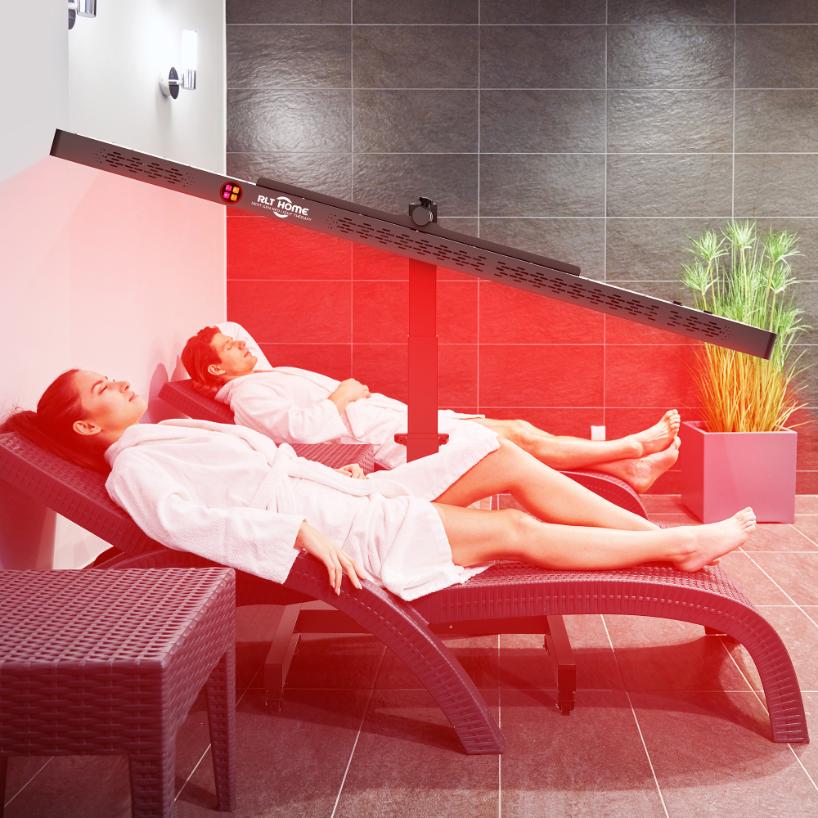
The Ultra (64.3 inch tall) and Elite (65 inch tall) are the only full-body panels in the comparison that ship with a motorized electric stand included in the panel price. The stand tilts horizontal so users can lie under the panel for full-body sessions. Joovv, BlockBlueLight, Hooga, Bestqool, Infraredi, and most other brands sell the horizontal stand separately ($150 to $1,995 depending on brand). At the full-body lie-under use case, RLT Home is the only brand that does not add a separate stand purchase to the panel price.
🎓 Best for First-Time Buyers: Red Light Rising Advantage 450
Touchscreen interface with preset Advantage Modes that automatically calculate the distance to stand and the session length for the user’s chosen goal (skin, recovery, sleep, etc.). For a buyer who does not want to think about protocols and prefers a button-press experience, this is the easiest entry. RLT Home’s free personalised weekly plan is the closest equivalent for buyers who prefer human guidance over preset modes. Shop Red Light Rising Advantage.
Master Comparison Table: 15 Brands Side-by-Side
The table below summarises the published specs across all 15 brands. “Not published” means the brand does not disclose that figure on its public product or spec pages.
| Brand | Wavelengths | Density Published | LED Chip | Irradiance Method | Beam Angle | Warranty | Trial | Stand Included | Flagship Price |
|---|---|---|---|---|---|---|---|---|---|
| RLT Home | 7 (480-1064nm) | Yes (14% at 1064nm) | Single-chip 5W | Spectrometer peak (98-122 mW/cm²) | Multi-beam 15° / 30° / 60° | 3 yr | 60-day, no fee, free return | Yes (motorized on Ultra/Elite) | $4,595 (Elite, TOP10: $4,319) |
| PlatinumLED | 7 (480, 630, 660, 810, 830, 850, 1060nm) on BioMax Pro | Not published; LTI testing shows ~80% concentrated at 660+850nm | Single-chip 5W | Solar 292 / spectrometer peak 120 mW/cm² (BioMax Pro Ultra) | Not published | 3 yr | 60-day, restocking | Door hook; XL stand $800 separate | $1,599 single (BioMax Pro Ultra); ~$3,198 2-panel |
| Mito Red Light | 4 to 8 (MitoPRO+ 4 bands; MitoPRO X 6; MitoADAPT 4.0 flagship 8 incl 940nm) | Yes on MitoPRO X (6%/22%/22%/17%/17%/17%) | Multi-chip 5W | Solar meter primary | 60° (multi-lens claim on MitoADAPT) | 3 yr | 60-day, no restocking, buyer pays return | Door hook; floor stand separate | MitoADAPT 4.0 flagship; MitoPRO MegaX multi-panel |
| Rouge | 8 (630, 650, 660, 670, 810, 830, 850, 1060nm) on G4 | Yes (~12.5% per band, multichip even split) | 5W multichip | Solar meter | 60° | 3 yr | 60-day; 20% restocking on stand returns | Separate ($350-$995) | $4,476 (Rouge Ultimate G4 panel only) |
| Hooga | 2 on HG/PRO (660+850); 4 on ULTRA (630/660/810/850nm) | Not published | Single-chip on HG; dual-chip on PRO; quad-chip on ULTRA | 165 mW/cm² solar (marketed); 100 mW/cm² per ULTRA1500 manual | 60° | 3 yr | 60-day, buyer pays return | Separate ($130.95 compact / $260.95 horizontal) | $1,220.95 (ULTRA1500 panel only) |
| Joovv | 2 (660 + 850nm) across entire catalog | Effectively 50/50 by construction (only 2 wavelengths) | Dual-chip 5W | Solar meter (>100 mW/cm²) | Not published | 2 yr | 60-day, buyer pays return | Separate ($200-$250) | $11,099 (Elite 3.0 panel only); 8-model Solo-chain lineup |
| BlockBlueLight | 7 (590, 630, 660, 810, 830, 850, 1060nm) | Yes (9% at 1060nm; 16% amber at 590nm) | Dual-chip 5W | Both solar (167) + spectrometer average (87 mW/cm²) | 60° (flat) | 5 yr | 30-day, buyer pays return | Separate ($39.95 portable / $131.95 base / $369.95 horizontal) | $4,499.95 (ULTIMATE XXL); 10 panel models in lineup |
| Vital Red Light | 9 (480-1060nm) on 2.0 | Not published | 5W (chip type not specified) | Not disclosed (150-210 mW/cm²) | Not published | 3 yr | 30-day, buyer pays return | Separate ($99-$1,995) | $1,499 (Elite 2.0); $11,995 commercial |
| BON CHARGE | 2 (660 + 850nm) | Not published | Not published | Not disclosed (>142-162 mW/cm²) | Not published | 1 yr | 30-day | Not included (door hook on Max) | $1,599 (Super Max) |
| Bestqool | 4 (630-940nm) on Pro300 | Not published | Dual-chip | Solar (106 mW/cm² @ 3″) | Not published | 2-3 yr | 30-day | Door hook; stand separate | $899 (Pro300) |
| Infraredi | 5 (630-850nm) | Not published | Dual-lens / dual-chip 5W | Solar (250+ mW/cm²) | Not published | 3 yr | 60-day, return ship deducted | Separate ($99-$949) | $6,099 (Pro Elite Plus 2.0) |
| iRestore Apex | 8 (590-1060nm) | Not published | Dual-chip 5W | Claimed >200 mW/cm² @ 6″ | Not published | 10 yr | 60-day, no fee | Door mount; floor $159, motorized $899 | $1,599 (Apex Elite 2160) |
| Red Light Rising | 5 (630-850nm) on Advantage | Not published as % | Single-chip (inferred) | Spectrometer (Hopoocolor) | Not published | 3 yr | 365-day, buyer pays return | Free door kit + free stand with Advantage | ~$1,755 (Advantage 900) |
| GembaRed | Up to 5 per panel (630-1050nm) | Yes (per-panel split) | Mixed (double-chip on Triton/Vulcan) | 3rd-party spectrometer | 60°-90° (flat) | 2 yr (10 yr on Triton) | 60-day, buyer pays return | Built-in kickstand only | $790 (Vulcan) |
| Helio Cure | 6 (630, 660, 810, 830, 850, 1064nm); no blue, no amber | Brand publishes highest 1064nm allocation across lineup; per-band percentages not tabulated | Not disclosed | LightLab International 3rd-party tested | 19° focused beam | 3 yr | 60-day risk-free, free USA shipping | Free USA shipping; stand not specified | $4,999 (Helio Nova flagship) |
| Kineon Move+ | 2 (660 LED + 808 laser) | n/a (wrap, not panel) | VCSEL laser + LED | n/a (210 mW optical per module) | n/a (direct contact) | 1 yr | 30-day | n/a (strap-on) | $434 |
The 5 Things That Actually Separate One Panel From Another
1. Wavelength Density (Not Just Wavelength Count)
Counting wavelengths is the wrong question. A panel with 9 listed wavelengths is not automatically better than one with 7. What matters is how the panel allocates its LEDs across those bands. A 9-wavelength panel that splits its allocation 11 percent per band reaches deep tissue less effectively than a 7-wavelength panel that puts 33 percent of its output specifically at 810nm + 1064nm.
Five brands publish per-band density in some form: RLT Home (33 percent at 810nm + 1064nm combined), BlockBlueLight (23 percent at 810nm + 1060nm combined, with 16 percent allocated to 590nm amber surface light), Mito Red Light on the PRO X series (17 percent at 810nm; no 1064nm anywhere in the catalog), Rouge G4 (effectively ~12.5 percent per band across 8 wavelengths via multichip even split), and GembaRed (per-panel splits published, typically 20 percent per band on multi-wavelength panels, 50/50 on dual-wavelength panels). PlatinumLED does not publish a per-band density table but independent Light Therapy Insiders spectrometer testing shows roughly 80 percent of BioMax Pro Ultra output concentrated at 660nm + 850nm. Joovv has only 2 wavelengths so density is effectively 50/50 by construction. Every other brand publishes only the wavelength list.
For buyers prioritising deep tissue, joint, or brain effects: RLT Home’s 33 percent published allocation at the deepest-penetration bands is the highest verified number in the category and the closest match to what the photobiomodulation literature most strongly supports.
2. Beam Angle (How Much Light Actually Reaches You)
A 60-degree beam angle means each LED’s light spreads in a wide cone. At a 6 to 18 inch treatment distance, a meaningful percentage of that output misses the body and lands on the walls, floor, or ceiling. Narrower beam angles concentrate more output onto the user.
RLT Home Ultra and Elite use a multi-beam lens system combining 15-degree, 30-degree, and 60-degree angles in the same panel. The 30-degree High-Potency Core delivers concentrated output to the body, the 60-degree Uniform Coverage fills coverage, and the 15-degree outer lenses prevent sideways spill. PlatinumLED uses a dual 30°/60° system. Every other brand in this comparison uses a flat 60-degree beam (or does not publish its beam angle at all). Even when raw irradiance numbers look similar across brands, the multi-beam design means more of the panel’s output actually reaches the user.
3. Irradiance Measurement Method (Solar Meter vs Spectrometer)
Solar power meters over-report LED irradiance by roughly 1.7x to 2x. Spectrometers are the accurate reference. Brands that publish only the solar-meter figure (which is most of them) are not lying, but they are publishing a number that is not directly comparable to the spectrometer-verified figures from brands that publish both.
Two brands publish both solar and spectrometer figures side-by-side: BlockBlueLight (167 mW/cm² solar / 87 mW/cm² spectrometer average on the MEGA) and PlatinumLED (292 mW/cm² solar / 120 mW/cm² spectrometer peak on the BioMax Pro Ultra per Light Therapy Insiders testing). RLT Home publishes spectrometer-verified peak figures across every device (98.7 to 121.6 mW/cm² at 6 inches). Red Light Rising publishes Hopoocolor spectrometer measurements. GembaRed publishes 3rd-party spectrometer data. Hooga publishes a 165 mW/cm² solar headline plus a closer-to-true 100 mW/cm² figure on the ULTRA1500 manual. Vital Red Light, BON CHARGE, Bestqool, Joovv, Mito, Rouge, and Infraredi publish solar-meter figures as their headline number without always specifying the method. For honest peak-to-peak comparison, only the spectrometer-verified figures should be compared against each other.
4. LED Chip Construction (Single-Chip vs Dual-Chip)
Single-chip 5W LEDs place one wavelength die per 5W package. Dual-chip 5W LEDs put two wavelength dies in each 5W package, splitting the power budget between bands. Single-chip produces higher per-band peak output and enables study-tuned density weighting (such as 19 percent at 810nm). Dual-chip produces broader simultaneous coverage on every spot of the panel but lower per-band peak.
Single-chip: RLT Home, PlatinumLED, Red Light Rising, Hooga HG series. Dual-chip: BlockBlueLight, Joovv, Infraredi, iRestore Apex, Bestqool, Hooga PRO series, GembaRed (on Triton and Vulcan). Multi-chip (3+ wavelength dies per package): Rouge G4, Mito PRO X, Hooga ULTRA (quad-chip). Chip type unspecified: Vital Red Light, BON CHARGE. There is no universal winner, the right chip type depends on whether the buyer prioritises peak output per band or broad simultaneous coverage. RLT Home’s combination of single-chip 5W + study-tuned density is the most science-driven configuration in the comparison.
5. Trial, Warranty, and What Comes in the Box
The post-purchase terms vary widely. RLT Home and several others offer 60-day trials. Red Light Rising offers 365 days. BlockBlueLight and BON CHARGE offer 30 days. Restocking fees, return shipping responsibility, and “must be in original packaging” requirements vary brand by brand. iRestore Apex offers the longest warranty at 10 years; BlockBlueLight at 5 years; most others at 3 years; BON CHARGE at 1 year.
Included accessories matter at the price tiers where buyers expect them. RLT Home’s full-body Ultra and Elite ship with a motorized electric stand and two sets of eye protection in the box. Red Light Rising includes a stand and door-hanging kit with every Advantage panel. iRestore Apex includes a door mount but charges $159 to $899 extra for a floor or motorized stand. Most other brands sell stands and eye protection as separate purchases. At the flagship tier specifically, this can mean $400 to $1,000 in additional purchases before the panel is set up for full-body sessions.
Brand-by-Brand Verdict
The 15 brand verdicts below are ordered by overall scoring on the five factors above, with the deepest analysis given to the brands that compete most directly with each other. Where a dedicated head-to-head article exists on this site, it is linked at the end of the verdict.
1. RLT Home (the comparison anchor)
Best for: Buyers prioritising verifiable deep-tissue effectiveness, complete in-box setup, and post-purchase support.
RLT Home’s Total Spectrum series spans the Mini ($595) to the Elite ($4,595). The 7-wavelength spectrum (480nm blue, 630nm + 660nm red, 810nm + 830nm + 850nm NIR, 1064nm deep IR) is published with full per-band density (14 percent at 1064nm, 19 percent at 810nm, 33 percent combined at the deepest-penetration bands). The Ultra and Elite use a multi-beam 15° / 30° / 60° lens system that concentrates output onto the body rather than scattering to the surrounding room. Spectrometer-verified irradiance is published across the line (98.7 to 121.6 mW/cm² peak at 6 inches). The Ultra and Elite ship with a motorized electric stand and two sets of eye protection included at no extra cost. Every customer receives a free personalised weekly usage plan written by the science team. 60-day trial, no restocking fee, free insured return shipping, 3-year warranty. HSA/FSA via TrueMed. TOP10 affiliate code adds 6 percent off at checkout.
Where RLT Home loses: the warranty is 3 years against iRestore Apex’s 10 and BlockBlueLight’s 5. The Total Spectrum line does not include a 590nm amber band, so buyers who specifically want amber for skin or mood work would look at Vital Red Light or iRestore Apex.
2. PlatinumLED BioMax Pro Series

Best for: Buyers who want a 7-wavelength single-chip premium panel and don’t need RLT Home’s personalised plan.
PlatinumLED is the long-standing premium category leader and the brand most directly comparable to RLT Home on engineering. The BioMax Pro line offers 7 wavelengths (480, 630, 660, 810, 830, 850, 1060nm), single-chip 5W LEDs, and a flagship BioMax Pro Ultra at $1,599 single panel (432 LEDs). Solar-meter primary irradiance reporting (292 mW/cm²) plus published spectrometer peak of 120 mW/cm². 3-year warranty, 60-day trial with restocking fee. Recommended modular two-panel build comes in around $3,198 plus an $800 XL stand. PlatinumLED’s main weaknesses against RLT Home: per-band density not published, and independent Light Therapy Insiders spectrometer testing shows roughly 80 percent of BioMax Pro Ultra output concentrated at 660nm and 850nm rather than evenly distributed across the listed seven wavelengths. The 1060nm band registers only a faint trace in independent testing. No included motorized stand on flagship; no free personalised usage plan. Read the full PlatinumLED vs RLT Home comparison | Shop PlatinumLED.
3. Mito Red Light

Best for: Buyers who want a wide-spectrum panel from a brand-name competitor with published density on the mid-tier series.
Mito’s lineup ranges from MitoPRO+ (4 wavelengths: 630/660/830/850nm) up to MitoPRO X (6 wavelengths, adding 590nm and 810nm) and the flagship MitoADAPT 4.0 (8 wavelengths: 590, 630, 660, 670, 810, 830, 850, 940nm). No Mito panel includes 1064nm at the deepest band; the MitoADAPT’s deepest is 940nm. Multi-chip 5W LEDs. Solar-meter primary irradiance. 3-year warranty. 60-day trial with no restocking fee and buyer-paid return shipping (optional Free Returns add-on at checkout). Stand sold separately. The MitoPRO X series publishes per-band density (6 percent at 590nm, 22 percent at 630nm, 22 percent at 660nm, 17 percent at 810nm, 17 percent at 830nm, 17 percent at 850nm). MitoADAPT 4.0 also offers 11 condition-specific treatment modes. Mito’s strength is brand recognition and the published density on the PRO X line; weaknesses against RLT Home are the lack of 1064nm anywhere in the lineup and the lower deep-penetration allocation (17 percent at 810nm vs RLT Home’s combined 33 percent at 810nm + 1064nm). Read the full Mito vs RLT Home comparison | Shop Mito Red Light. Mito Red Light review.
4. Rouge
Best for: Buyers wanting the widest wavelength count (8 bands) with even ~12.5 percent allocation across the spectrum.
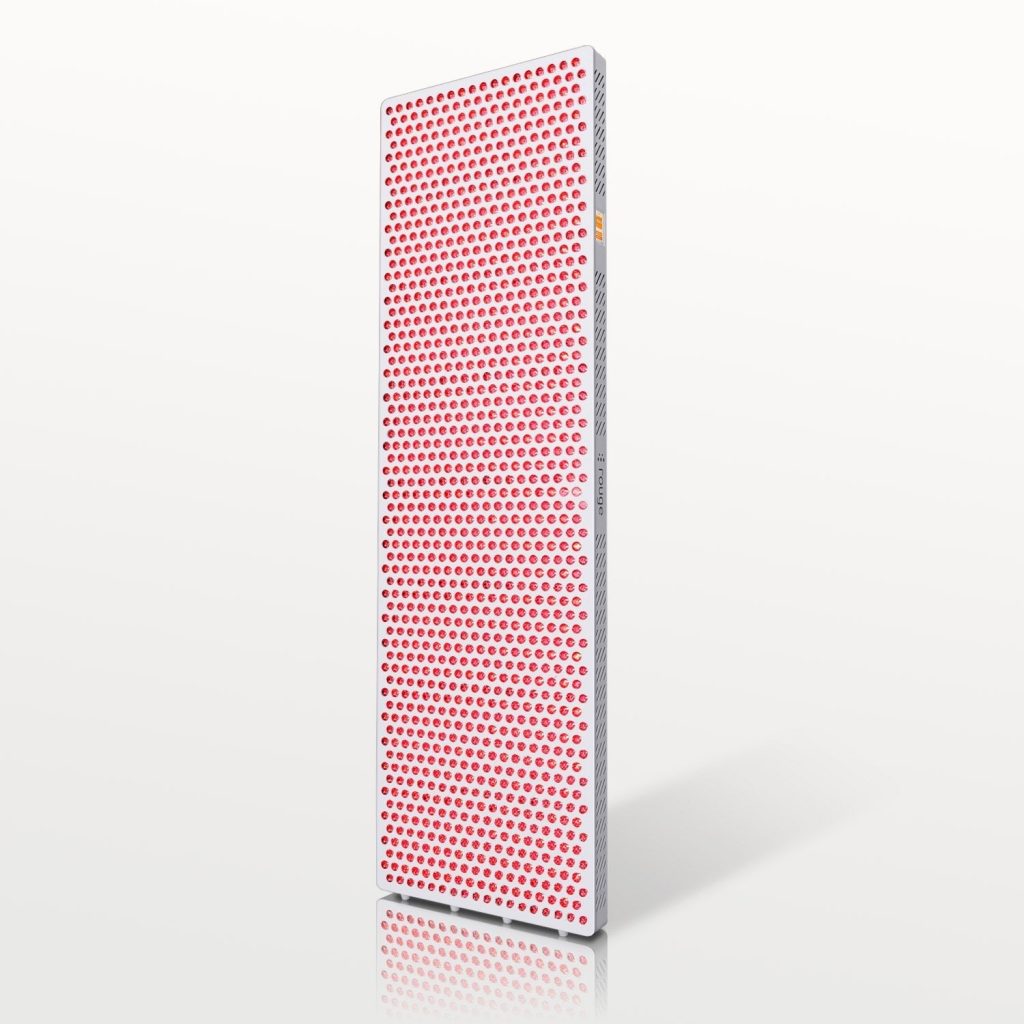
5W multichip LEDs (multiple wavelength dies share each 5W package), 8 wavelengths on the Rouge G4 series (630, 650, 660, 670, 810, 830, 850, 1060nm), including 1060nm deep IR. Density is effectively ~12.5 percent per band across all 8 wavelengths via the multichip even split (~50 percent of output lands in the red region; the deepest 1060nm band gets the same ~12.5 percent share as every other band). Solar-meter irradiance. 3-year warranty, 60-day satisfaction guarantee with 20 percent restocking fee on stand returns. Tabletop G4 model includes per-wavelength dimming and 1 to 10,000 Hz pulsing options. Stand sold separately ($350 floor to $995 motorized). Rouge HQ is in Canada; panels are manufactured in China and ship from Canada, US, or China warehouses depending on availability. Flagship Rouge Ultimate G4 is $4,476 panel only (about $4,826 with floor stand). Where Rouge wins against RLT Home: wider wavelength count (8 vs 7) and tunable pulsing modes on Tabletop. Where RLT Home wins: study-tuned density weighted to deep bands (33 percent at 810nm + 1064nm) vs Rouge’s even ~12.5 percent split, multi-beam lens system, included motorized stand. Read the full Rouge vs RLT Home comparison | Shop Rouge. Rouge review.
5. Hooga

Best for: Budget-conscious buyers who want a credible mid-tier panel and don’t need a 1064nm deep band.
11-panel lineup across HG (single-chip, 2 wavelengths: 660+850nm), PRO (dual-chip, 2 wavelengths), and ULTRA (quad-chip, 4 wavelengths: 630/660/810/850nm). The flagship ULTRA1500 is the only Hooga panel with 810nm. Deepest wavelength across the entire catalog is 850nm; no 940nm or 1064nm anywhere. Narrow profile (8.6 inch wide ULTRA1500) means buyers wanting a lie-under setup need to chain two panels. Hooga publishes 165 mW/cm² solar-meter (marketed headline) plus a 100 mW/cm² figure on the ULTRA1500 included manual (closer to true spectrometer reading). Per-band density not formally published, though the chip architecture (single/dual/quad) effectively dictates allocation. 3-year warranty, 60-day trial with buyer-paid return shipping. Flagship ULTRA1500 is $1,220.95 panel only; stand $130.95 compact or $260.95 horizontal sold separately. Read the full Hooga vs RLT Home comparison | Shop Hooga. Hooga review.
6. Joovv

Best for: Buyers who specifically value app connectivity, patented pulsed Recovery+ mode, and modular Solo-chain linking.
8-model lineup (Go 2.0, Mini 3.0, Solo 3.0, Half-Max 3.0, Duo 3.0, Max 3.0, Quad 3.0, Elite 3.0) with only 2 wavelengths across the entire catalog (660nm + 850nm), the shortest spectrum in the comparison. No 810nm, 830nm, 940nm, or 1064nm on any Joovv panel. Dual-chip 5W LEDs (per-band density effectively 50/50 by construction). Solar-meter irradiance (>100 mW/cm² published, method and distance not always specified). The Joovv Solo 3.0 is 8.75 inch wide × 36 inch tall, requiring two Solos chained vertically (Duo) for a lie-under setup. Duo reaches 72 inches tall but stays 8.75 inches wide. Elite 3.0 is 6 Solos chained. 2-year warranty (shortest of premium brands). 60-day trial with buyer-paid return. Joovv Elite 3.0 is $11,099 panel only, the most expensive flagship in this comparison by a wide margin. Joovv app (Bluetooth, session tracking, timer control) and patented Recovery+ pulsed mode are the brand’s genuine differentiators. Read the full Joovv vs RLT Home comparison | Shop Joovv.
7. BlockBlueLight

Best for: Buyers prioritising warranty length and an amber-weighted spectrum.
Australian family-owned brand with a 10-model PowerPanel lineup (Target Torch handheld, Portable, Mini, TABLETOP, MID, PRO, MAX, MEGA, ELITE XL, ULTIMATE XXL flagship at $4,499.95). 7 wavelengths (590, 630, 660, 810, 830, 850, 1060nm), dual-chip 5W LEDs, 5-year warranty (longest in the comparison apart from iRestore Apex), and published density on the PowerPanel MEGA spec sheet (16 percent at 590nm amber, 17 percent at 660nm, 17 percent at 630nm, 14 percent at 810nm, 14 percent at 830nm, 13 percent at 850nm, 9 percent at 1060nm, for 50 percent of total allocation in the red and amber surface bands; 23 percent at the deepest-penetration 810nm + 1060nm combined). One of two brands in the comparison publishing both solar (167 mW/cm²) and spectrometer-verified average (87 mW/cm²) irradiance figures side-by-side. Flat 60-degree beam angle across the entire line. 30-day trial with buyer-paid return shipping. Stand sold separately ($39.95 portable / $79.95 wall / $131.95 base / $154.95 deluxe floor / $369.95 horizontal). Eye protection $19.95 separate. Read the full BlockBlueLight vs RLT Home comparison | BlockBlueLight review | Shop BlockBlueLight.
8. Vital Red Light

Best for: Buyers who specifically value 9-wavelength count and don’t need verified density data.
8-model lineup spanning the Vital Charge handheld ($299) to the Vital Bed commercial system ($24,995). The 2.0 series (Pro 2.0, Elite 2.0, and the commercial Premier/Ultimate/Bed) offers 9 wavelengths including 480nm blue, 590nm amber, and 1060nm deep IR. The widest published spectrum in the comparison. Per-band density not published, LED count not published, beam angle not published, irradiance method not disclosed (150 to 210 mW/cm² claimed, distance not stated, likely solar meter). 3-year warranty (was 2 years prior to April 2025). 30-day trial with customer-paid return shipping. Every stand sold separately ($99 to $1,995). Eye protection not mentioned as included. HSA/FSA via Flex. The brand markets heavily on athlete and celebrity partnerships (NFL, MLB, PGA, Equinox, Forbes). Strong consumer brand pull; weaker on engineering transparency. Shop Vital Red Light. Read the full Vital Red Light vs RLT Home comparison.
9. BON CHARGE

Best for: Buyers building a full lifestyle wellness ecosystem (blue blockers, sauna blankets, EMF gear) and wanting a single brand across categories.
Australian brand best known for non-panel wellness products. The red light panel line is a secondary category. 4-panel lineup (Mini $299, Demi $699, Max $999, Super Max $1,599). Only 2 wavelengths (660 + 850nm), among the narrowest spectrums in the comparison. No published density, no published LED count, no published LED chip type, no published beam angle. Irradiance figures (Super Max >162 mW/cm², Max >142, Demi and Mini >100) published without method disclosure. 1-year warranty (shortest in the comparison). 30-day trial. Stand and eye protection not included. The strength is the brand ecosystem, not the panel specs. HSA/FSA via TrueMed. Shop BON CHARGE.
10. Bestqool

Best for: Lowest entry-level budget buyers who want an Amazon-convenient purchase.
Chinese brand with US distribution office. Lineup spans the BQ40 handheld ($89) to the Pro300 flagship ($899, refurb $719). FDA 510(k) cleared as Class II. Pro300 offers 4 wavelengths (630/660/850/940nm, no 1064nm deep IR), 300 dual-chip LEDs, 106 mW/cm² at 3 inches (solar-meter equivalent). 2-3 year warranty (extendable). 30-day return. Stand sold separately. The win is price floor, Bestqool offers the cheapest credible entry into the category. The loss is depth and verification. Shop Bestqool.
11. Infraredi

Best for: Buyers wanting a modular upgrade path and a half-body tier that other brands skip.
Australian brand with 8-panel lineup spanning Pro Mini 2.0 ($699) to Pro Studio 2.0 ($6,299) and Pro Elite Plus 2.0 ($6,099). Dual-chip 5W LEDs marketed as “dual-lens.” 5 wavelengths (630/660/810/830/850nm, no 480nm blue, no 1060nm deep IR). 250+ mW/cm² claimed via solar meter (over-reports vs spectrometer). 3-year warranty. 60-day trial with return shipping deducted from refund (not a free return). Stand sold separately ($99-$949). Modular linking (“Buy Now And Upgrade Later”) lets buyers start with one panel and chain more later. Larger half-body Pro Max Plus sits between RLT Home Compact and Max as a category RLT Home doesn’t directly fill. Shop Infraredi. Infraredi review. Read the full Infraredi vs RLT Home comparison.
12. iRestore

Best for: Hair growth (helmet), or buyers prioritising 10-year warranty on a panel.
The Apex panel line (Pro 1500 $999, Elite 2160 $1,599) is iRestore’s secondary product category. The flagship helmet (Elite at $1,899) is the brand’s heritage and the only FDA 510(k) cleared hair-growth device in this comparison, backed by a double-blind clinical trial. The Apex panels offer 8 wavelengths (590, 630, 660, 810, 830, 850, 940, 1060nm), dual-chip 5W LEDs, 10-year warranty (longest in the comparison), claimed >200 mW/cm² at 6 inches (method not disclosed). The Apex panels are FDA 510(k) exempt, not cleared, a lighter regulatory pathway than the helmet. 60-day trial, no restocking fee. Door mount included; floor stand $159 and motorized $899 separate. Eye protection $60 separate. HSA/FSA eligible. Shop iRestore.
13. Red Light Rising

Best for: UK and EU buyers, or US buyers willing to pay international shipping and import duty for the touchscreen UX.
UK’s longest-running red light therapy brand (founded 2017). 3-panel lineup (Half Stack £599, Advantage 450 £920, Advantage 900 £1,380). The Advantage series adds a touchscreen with preset modes that auto-calculate session distance and duration. 5 wavelengths (630, 660, 810, 830, 850nm) on the Advantage models. Spectrometer-measured irradiance (Hopoocolor OHSP-350F). 3-year warranty. 365-day money-back trial (the longest in the comparison), with customer-paid tracked international shipping for US returns and 100 percent original packaging requirement. Free door-hanging kit and complimentary stand included with every Advantage panel. Best for UK or EU buyers; US buyers face import duty and return shipping costs. Shop Red Light Rising.
14. GembaRed

Best for: Biohacker buyers prioritising EMF, flicker, and 3rd-party-verified data.
Small US brand founded by a former aerospace engineer. 11-panel lineup spanning Beam LX Mini ($199) to Vulcan ($790). Mixed chip construction (double-chip on heavy-duty Triton and Vulcan; single-emitter on most others). Published per-panel density splits (uncommon in the category). 3rd-party spectrometer testing, low-flicker (0.3 percent on Beacon 3.0) and best-in-class EMF (0.66 mG at 0 inches on Beacon 3.0) genuinely lead the comparison. Trade-offs: no full-body single panel, no included stand options (kickstand only), no eye protection sold or included, panels marketed as “general wellness” rather than FDA registered. 2-year warranty on most panels (10 years on Triton heavy-duty). 60-day trial with buyer-paid return. Shop GembaRed.
15. Helio Cure

Best for: Buyers who want a circadian-friendly red light spectrum with no blue and no amber bands, focused beam, and conservative single-vendor architecture.
US brand (Quantron LLC, West Hollywood, CA) built explicitly around the “no blue light, on purpose” philosophy. 4-panel lineup: Helio Spark ($549 targeted), Helio Glow ($1,199 larger zones), Helio Blaze ($2,799 full body), Helio Nova ($4,999 head-to-toe flagship). Every device runs the same 6 wavelengths (630, 660, 810, 830, 850, 1064nm) and the same 5 condition-specific preset modes plus a full-spectrum mode plus custom settings. No 480nm blue, no 590nm amber. The brand argues blue light disrupts circadian rhythm and has no role in deep-tissue photobiomodulation. 19-degree beam angle is the most focused single-beam in this comparison (narrower than every other brand’s flat 60-degree default, though without the wider edge-coverage lenses that RLT Home’s multi-beam 15°/30°/60° system provides). Independent third-party tested by LightLab International. FDA-registered, CE/RoHS certified. Zero detectable EMF at standard use distance, flicker below the threshold of human perception. 60-day risk-free trial, 3-year warranty, free USA shipping, HSA/FSA via TrueMed. Where Helio Cure wins against RLT Home: focused 19-degree beam delivers higher per-spot intensity, the brand reports highest 1064nm allocation across its lineup (specific percentages not published), and the “no blue light” thesis is the clearest in the category. Where RLT Home wins: published per-band density (33 percent at 810nm + 1064nm combined), the 480nm blue band for buyers who want it for acne, multi-beam lens system that includes wider 60-degree lenses for edge coverage, motorized stand included on full-body models, two sets of eye protection in the box, and the free personalised weekly usage plan. Shop Helio Cure.
16. Kineon Helio Cure review.
16. Kineon Move+ (Different Category)

Best for: Localised joint pain treatment, not whole-body sessions.
A targeted wrap with 3 detachable modules combining 808nm laser diodes and 660nm LEDs. FDA 510(k) cleared as a Class II medical device for knee pain. Battery powered (4 hours per module). $434 USD. 1-year warranty, 30-day trial. Not a panel substitute, but the most credible targeted joint-pain option in the comparison. Many serious users own both a Kineon Move+ for targeted joints and a panel like the RLT Home Ultra for whole-body sessions. HSA/FSA eligible via Flex. Shop Kineon Move+.
How to Choose: Decision Framework
The right panel depends on the buyer’s primary goal, budget, and tolerance for marketing-tier vs engineering-tier brands.
If your primary goal is deep tissue, joint pain, muscle recovery, or brain support: Choose RLT Home (Ultra or Elite) for the published 33 percent deep-penetration allocation and multi-beam lens system. BlockBlueLight is the runner-up for buyers who specifically want the longer 5-year warranty.
If your primary goal is facial skin work or aesthetics: Choose Vital Red Light Elite 2.0 or iRestore Apex for the 9 / 8 wavelength count including 590nm amber. RLT Home Mini or Compact also works well at the face/spot level and includes 480nm blue for acne support.
If your primary goal is hair growth: Choose the iRestore Elite helmet for the FDA 510(k) clearance and published double-blind trial data. A panel can support hair growth at the scalp, but a helmet directly targeting the scalp is the higher-evidence option.
If your primary goal is targeted joint pain: Choose Kineon Move+ for the FDA 510(k) clearance and direct 808nm laser application to a single joint. Pair it with a panel for whole-body coverage.
If you have a $1,000 or less budget: RLT Home Total Spectrum Mini ($595) or Compact ($1,095) at the premium-but-affordable end. Bestqool BQ150 or Hooga PRO300 at the budget end. Avoid the Joovv Mini and Vital Pro at this tier, better specs are available for the money.
If you’re a UK or EU buyer: Red Light Rising Advantage 450 or 900 for the touchscreen UX, free included stand, and 365-day trial.
If you want a lifestyle ecosystem (blue blockers, sauna blankets, etc): BON CHARGE for the brand consistency, with the trade-off of a narrower 2-wavelength panel spectrum.
If you prioritise lowest EMF and best 3rd-party data: GembaRed Beacon 3.0 or Vulcan, with the trade-off of no full-body sizing.
Pricing Tier Breakdown
Entry / Spot Treatment ($89 to $700)
Bestqool BQ40 ($89), Joovv Go 2.0 ($549), RLT Home Mini ($595, ~$559 with TOP10), BlockBlueLight TABLETOP ($599.95), Mito Mini ($699), GembaRed Beacon 3.0 ($499), Vital Charge ($299), BON CHARGE Mini ($299), Kineon Move+ ($434), iRestore Apex (not at this tier).
Mid-Size Single Panel ($700 to $1,500)
RLT Home Compact ($1,095, ~$1,029 with TOP10), BlockBlueLight PowerPanel MID ($699.95) and MAX ($1,099.95), Hooga PRO ($199 to $799), Bestqool Pro300 ($899), GembaRed Vulcan ($790), Vital Pro 2.0 ($599), BON CHARGE Demi ($699) and Max ($999), iRestore Apex Pro 1500 ($999).
Larger Single Panel / Half-Body ($1,200 to $3,000)
RLT Home Max ($1,795, ~$1,687 with TOP10), BlockBlueLight MEGA ($1,499.95), Hooga ULTRA1500 ($1,220.95 panel only), Mito MitoPRO 1500X (~$1,599), Vital Elite 2.0 ($1,499), iRestore Apex Elite 2160 ($1,599), BON CHARGE Super Max ($1,599), PlatinumLED BioMax Pro Ultra ($1,599 single panel), Joovv Solo 3.0 ($1,699), Infraredi Pro Max Plus ($1,749).
Full-Body Lie-Under ($2,500 to $4,000)
RLT Home Ultra ($2,895, ~$2,721 with TOP10), Joovv Duo 3.0 ($3,699), Infraredi Pro Dual Plus 2.0 ($3,299), PlatinumLED BioMax Pro Ultra 2-panel build (~$3,198 + $800 XL stand), Mito MitoADAPT 4.0 / MitoPRO MegaX multi-panel configurations.
Flagship Full-Body ($4,000+)
RLT Home Elite ($4,595, ~$4,319 with TOP10), BlockBlueLight ULTIMATE XXL ($4,499.95 panel only, ~$4,870 with horizontal stand), Rouge Ultimate G4 ($4,476 panel only, ~$4,826 with floor stand), Infraredi Pro Elite ($4,399), Joovv Elite 3.0 ($11,099 panel only), Infraredi Pro Elite Plus 2.0 ($6,099), Vital Premier ($7,995) and Ultimate ($11,995) commercial.
Frequently Asked Questions
Which red light therapy brand publishes the most transparent specs?
Five brands publish per-band density in some form: RLT Home (full table per device, leading deep-penetration allocation), BlockBlueLight (full table on PowerPanel MEGA spec sheet), Mito Red Light (on the MitoPRO X series only), Rouge G4 (effective ~12.5 percent per band via multichip even split), and GembaRed (per-panel splits). On the irradiance side, RLT Home publishes spectrometer-verified peak across every device, BlockBlueLight publishes both solar and spectrometer-verified average side-by-side, PlatinumLED has third-party Light Therapy Insiders spectrometer data, Red Light Rising publishes Hopoocolor spectrometer measurements, and GembaRed publishes third-party spectrometer testing. Most other brands publish only solar-meter irradiance and the wavelength list without density.
Why is wavelength count not the best way to compare panels?
Wavelength count tells you what bands are present. Per-band density tells you how much of the panel’s output reaches each band. A 9-wavelength panel splitting allocation roughly evenly delivers about 11 percent at the deepest band. A 7-wavelength panel concentrating 14 percent at 1064nm delivers more deep-tissue output despite having fewer total wavelengths. For deep-tissue, joint, and brain effects, density matters more than count.
What is the difference between FDA registered, FDA cleared, and FDA exempt?
FDA registered means the manufacturer has registered the device with the FDA but has not undergone clinical review. Most red light panels are FDA registered. FDA cleared (510(k)) means the device has been reviewed against a predicate device and approved for specific marketing claims. iRestore’s hair-growth helmet is 510(k) cleared. FDA exempt means the device class is exempt from premarket review entirely. iRestore’s Apex panels are 510(k) exempt. Kineon Move+ is one of the few wrap/laser devices with full 510(k) clearance for knee pain.
Why does beam angle matter if the irradiance number looks good?
Irradiance is measured at a specific distance from the panel, usually 6 inches. A flat 60-degree beam panel spreads its output widely, so a meaningful share of the published irradiance hits the walls and floor at typical home setup distances, not the body. A multi-beam panel (15° / 30° / 60° on RLT Home, 30° / 60° on PlatinumLED) concentrates more output onto the user. Effective dose at the body, not raw irradiance, is what matters for results.
Are any of these panels covered by HSA or FSA?
Most are eligible with a Letter of Medical Necessity. RLT Home, BON CHARGE, Bestqool, iRestore, Kineon, and Vital Red Light all integrate with HSA/FSA workflows at checkout (TrueMed, Flex, or Sika). Always confirm eligibility with your specific plan.
What does the TOP10 code do?
TOP10 is the affiliate code for RLT Home (rlthome.com). It applies an extra 6 percent off at checkout sitewide, which at the flagship Elite tier saves approximately $276, dropping the price from $4,595 to about $4,319 all-in with the motorized stand and eye protection included.
Should I buy a wrap like Kineon instead of a panel?
Choose a wrap if your goal is localised joint pain on a specific joint (knee, elbow, shoulder, ankle). Choose a panel if your goal is whole-body coverage, recovery, skin work, or daily wellness. Many serious users own both. The wrap and panel are complementary, not substitutes.
Which brand is best for a buyer who wants the absolute longest warranty?
iRestore Apex panels at 10 years, then BlockBlueLight at 5 years, then most premium brands at 3 years. BON CHARGE at 1 year is the shortest. Note that the iRestore Apex panels are 510(k) exempt, so the regulatory pathway is lighter than the iRestore helmet line.
Conclusion: The Best Red Light Therapy Panel for Most Buyers in 2026
The category has matured into a clear two-tier structure. The top tier publishes per-band density, spectrometer-verified irradiance, and engineered lens systems: RLT Home and BlockBlueLight lead this group. The second tier publishes wavelength lists and solar-meter irradiance figures, relying more on brand marketing than published engineering. Most brands sit in the second tier.
For most buyers, the RLT Home Total Spectrum Ultra is the best overall choice in 2026. The combination of 7 wavelengths with 33 percent allocation to the deepest-penetration bands, multi-beam lens system that delivers more of the published irradiance to the body, spectrometer-verified data, included motorized stand and eye protection, free personalised weekly usage plan from the science team, and 60-day trial with no restocking fee and free insured return shipping makes it the clearest value at the full-body tier. The TOP10 affiliate code drops the Ultra to about $2,721 all-in.
For buyers with different priorities: BlockBlueLight for the 5-year warranty and amber-weighted spectrum. iRestore for hair growth via the FDA-cleared helmet. Kineon Move+ for targeted joint pain. BON CHARGE for the broader lifestyle wellness ecosystem. Red Light Rising for UK and EU buyers wanting touchscreen UX. GembaRed for biohacker buyers prioritising low EMF and flicker. Vital Red Light for buyers who specifically value 9-wavelength count and accept that the engineering data is not publicly verified.
The best panel is the one that matches your specific goal. The data above is the most honest read on which brands deliver what they market.