

Red Light Therapy Top 10 · Brand review · September 2026
Leredd Red Light Therapy Review (2026)

Medical review: Articles on Red Light Therapy Top 10 are reviewed for scientific accuracy by our medical expert team. This page is wellness information, not a diagnosis or a treatment plan. Leredd markets BIOHAX panels as home and clinic wellness devices. Sessions with red and near-infrared light may help some people. They are not a substitute for clinical care.
Leredd is a Melbourne red light company, founded in 2018, with a Bentleigh showroom and a BIOHAX line that uses dual-chip (Bi-Chip) LEDs. Live 1 September 2026 prices are in Australian dollars. Tall panels run 630, 660, 830, and 850 nm. The 5-year warranty, checked live, covers the internal LED driver, not the whole chassis. This is a dedicated brand review, not a versus page, and it does not crown a market panel.
Brand snapshot
What Leredd is in 2026
leredd.com is a Shopify storefront whose live products.json held 55 products on 1 September 2026. Headquarters copy places the company in Melbourne, with a Bentleigh showroom and the line “Trusted Since 2018.” Store currency on the Australian cart is AUD. A US IP sees Shopify Markets convert the same SKUs to USD. This review quotes the live Australian stickers first, then an approximate dollar figure at a named FX print. The BIOHAX rectangular panels are the subject. Wraps, domes, gloves, caps, oral and nasal devices, and the Photon / MitoCharge beds sit in the same catalog and are named only so they are not scored as panels.
The pitch is Australian dual-chip glass, 240 V plug-and-play, a local showroom, and a 5-year driver warranty. Dual-chip, printed as Bi-Chip LED Technology on the 324 and 432 pages, is a packaging fact. Sessions with 630, 660, 830, and 850 nm light may help people who want a four-band panel in a 240 V room. They may help less if the buyer needs a published 6-inch spectrometer table, a whole-unit warranty, or FDA-cleared language that matches a 510(k).
The 2026 Leredd BIOHAX panel lineup
The live BIOHAX family is two desktops, one sold-out mid panel, one modular mid panel, one half-to-tall M3, and one full-height M3. Height and LED count scale. Width on the tall glass stays near 36 cm. Every sticker below comes from the AUD product page or the matching products.json variant the same day.
BIOHAX M4 40 (40 dual-chip LEDs, desktop)

M4 40 is the small desktop: 40 dual-chip LEDs and six listed wavelengths (460 nm blue, 590 nm yellow, 630 nm red, 660 nm deep red, 830 nm NIR, 850 nm NIR). Live copy says up to 380 mW/cm² at direct skin contact via spectroradiometer, not solar meter. The instrument model is not named. No stand required. Live A$438. Contact milliwatts are not a 6-inch figure, and this page does not invent one. Sessions with those six bands at a desk may help a targeted wellness routine.
Biohax 60 (60 dual-chip LEDs, desktop)

Biohax 60 is the two-band desktop: every lens emits 660 nm and 850 nm together. Live copy: up to 78 mW/cm² at 15 cm, spectroradiometer measured. Fifteen centimetres is about 5.9 inches. That is the only BIOHAX panel on the live cards that prints both a number and a working distance other than contact. The meter model is still unpublished. Glasses and a remote are listed as recommended add-ons. Live A$713. Prices on that page exclude GST for Australian customers.
BIOHAX M2 300 (300 dual-chip LEDs, sold out)

M2 300 is the two-band mid panel: 300 dual-chip LEDs, each firing 660 nm and 850 nm. Live copy: half-body coverage, 5W dimmable LEDs, touchscreen and remote, 5-year driver warranty. The comparison chart on the same page marks “TGA Cleared (Australia).” The kit section lists an adjustable floor stand, remote, and blackout goggles. Live A$2,200 versus A$3,900, sold out, with a pre-order note. No numeric irradiance on the live product JSON. Because the SKU is on sale, the refund line “Sale items cannot be refunded” applies if stock returns.
BIOHAX 324 Modular (324 dual-chip LEDs, 83 x 36 x 6 cm)

324 Modular is the buildable M3: 324 Bi-Chip LEDs, alternate diodes 630+830 nm and 660+850 nm, 60-degree beam, tempered glass, 5W dimmable, touchscreen or remote. Pulse on this SKU is 10 Hz or 40 Hz or constant, not a 10 to 1000 Hz sweep. Presets: Muscle, Sleep, Pain, Skin. Live dimensions: 83 x 36 x 6 cm, net weight 11.2 kg (Shopify variant weight the same day was 15.6 kg). Modular copy: more 324 panels can be added later. Extra chassis increase coverage area, not irradiance on one square of skin.
The kit section lists a floor stand on lockable casters, wireless remote, glare-diminishing glasses, AU power cable, and e-manual. That same paragraph currently describes the 324 as a “432 dual-chip LED panel,” leftover 432 wording on a 324 page. The rest of the page correctly says 324 LEDs. The same page still invites buyers to pair the 324 with a horizontal/vertical or electric stand. Both the included-stand kit line and the accessory upsell were live on 1 September 2026. Live A$2,418 versus A$4,950, a sale sticker. The refund policy says sale items cannot be refunded.
BIOHAX M3 432 (432 dual-chip LEDs, 110 x 36 x 6 cm)

M3 432 is the taller four-band panel: 432 Bi-Chip LEDs, same 630+830 / 660+850 pair, 60-degree beam, red-only / NIR-only / both, 5W dimmable, tempered glass, touchscreen and remote. Pulse here is 10 Hz to 1000 Hz, or constant. Five cooling fans are listed. Live dimensions: 110 x 36 x 6 cm, 15.5 kg on the page (variant weight 15.6 kg). Kit copy lists an adjustable floor stand, wireless remote, blackout goggles, AU cable, and user manual. Accessory tiles still sell the horizontal/vertical and electric stands. Live A$3,848, not on a compare-at sale in the AUD feed. No numeric irradiance on the live product JSON. The page claims spectroradiometer measurement and names a “Leredd Spectroradiometer Measurement Protocol” without printing the table.
BIOHAX M3 648 (648 dual-chip LEDs, 160 x 36.5 x 6 cm)

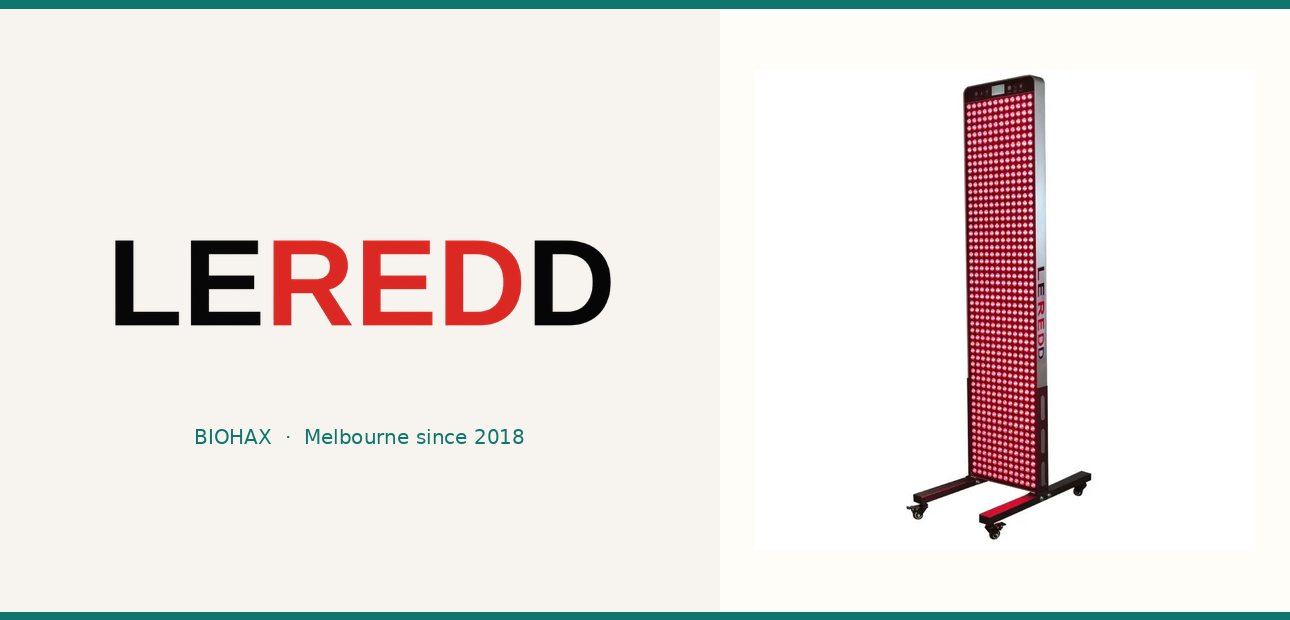
M3 648 is the full-height flagship: 648 dual-chip LEDs, 5W dimmable, touchscreen with remote, 240 V / 10 A, 60,000-plus hour lifespan claim, six cooling fans, connectability with other Biohax models. Live tech specs: 28 kg, 36.5 x 6 x 160 cm (about 14.4 x 2.4 x 63.0 in). The LED-count line is 648 pcs Bi Chip, RED 630+660 nm / NIR 830+850 nm. A second wavelength bullet on the same spec list names 810 nm. Marketing bullets on the same page stay on 630, 660, 830, and 850 nm. This review reports that inconsistency rather than inventing a fifth band.
Optical irradiance is printed as greater than 140 mW/cm². Distance is not stated. Instrument is not named on that spec row. This page does not invent a 6-inch figure. What’s included, live: 648 panel with remote, glare-diminishing glasses, floor stand on lockable wheels for vertical treatment, AU power cord, instructional e-manual. Live A$6,478.98. The page showed a low-stock flag of 1 left on 1 September 2026.
Paid upgrades in the same feed include the horizontal/vertical stand (A$699) and electric stands (A$1,399 / A$1,499). Photon and MitoCharge beds are not BIOHAX panels and are not scored as panels here.
Spectrum: four BIOHAX bands on M3, two on M2, six on the M4 desktop
Leredd publishes which wavelengths the diodes emit. It does not publish LED share inside a panel. Dual-chip packaging is how those bands are physically combined, not a density table.
On BIOHAX 324, M3 432, and M3 648, live copy says alternate LEDs emit 630 nm red plus 830 nm NIR, while the next emit 660 nm deep red plus 850 nm NIR. Wavelength selection on 324 and 432 lets the buyer run red only, NIR only, or both. M2 300 and Biohax 60 stay on 660 plus 850 nm, every dual-chip diode firing both. M4 40 is the six-band desktop: 460, 590, 630, 660, 830, 850 nm. There is no 1064 nm on any live BIOHAX card used here. 810 nm appears on the M3 648 tech-spec list and is not repeated on 324 or 432.
| Wavelength | Where it appears (live) | Published share | Usual role in the literature |
|---|---|---|---|
| 460 nm (blue) | M4 40 only | Not published as a percent | Surface, listed by Leredd for blemishes |
| 590 nm (yellow) | M4 40 only | Not published as a percent | Surface, listed by Leredd for tone |
| 630 nm (red) | 324, 432, 648, M4 40 | Not published as a percent | Surface skin |
| 660 nm (deep red) | Every BIOHAX panel here | Not published as a percent | Surface to shallow tissue |
| 810 nm | Named once on the M3 648 spec list; not on 324 or 432 | Not published | Deeper NIR in other catalogs |
| 830 nm (NIR) | 324, 432, 648, M4 40 | Not published as a percent | Deeper tissue in the four-band design |
| 850 nm (NIR) | Every BIOHAX panel here | Not published as a percent | Deeper tissue |
| 1064 nm | Not listed | n/a | Omitted |
That is a four-band M3 niche, a two-band M2 / Biohax 60 niche, and a six-band desktop, not a hidden seven-band panel. Sessions with 660 nm may help surface-oriented wellness routines. Sessions with 850 nm may help deeper-tissue wellness routines inside this design. Neither band is a treatment claim on this page.
Power and Irradiance: Measured by Independent Third Parties
Solar power meters over-report narrowband LED output, often by a large factor. Spectrometers are the accurate reference. Peak compares with peak. Average compares with average. A contact figure is not a 6-inch figure. A 15 cm figure is not an unstated-distance figure. This review never invents a 6-inch BIOHAX number.
Live 324 and 432 pages, checked 1 September 2026, state that 5W LEDs are “measured by spectroradiometer, the precision instrument used in clinical photobiomodulation research, not solar meters that inflate readings,” and they title a block “Leredd Spectroradiometer Measurement Protocol.” Those pages do not print a distance table, a 6-inch peak, or a named instrument model. The live product JSON bodies for 324, 432, and M2 300 contain no numeric irradiance.
What is actually numbered on 1 September 2026:
| Model | Published number | Distance | Method named on the card | Named third-party lab file |
|---|---|---|---|---|
| Biohax 60 | Up to 78 mW/cm² | 15 cm (about 5.9 in) | Spectroradiometer, model unpublished | Not linked on the live card |
| M4 40 | Up to 380 mW/cm² | Direct skin contact | Spectroradiometer, model unpublished | Not linked on the live card |
| M3 648 | Greater than 140 mW/cm² optical irradiance | Not stated | Not named on the spec row | Not linked on the live card |
| 324 Modular | None on the live JSON body | n/a | Spectroradiometer claimed in page copy | Not linked |
| M3 432 | None on the live JSON body | n/a | Spectroradiometer claimed in page copy | Not linked |
| M2 300 | None on the live JSON body | n/a | Not numbered | Not linked |
Why Leredd also says every device is “independently tested and verified for safety, irradiance output, and performance.” That sentence does not name a lab, a report date, or a distance. Theoretical wattage on M3 648 is listed as 3240W (648 x 5W). A 5W LED label is not 5W of optical output at the skin. If a buyer needs a 6-inch spectrometer peak with an instrument model, that file is not on these BIOHAX cards.
Takeaway: Spectroradiometer is claimed. Solar meters are rejected in copy. The only numbered, distance-stated BIOHAX figures on 1 September 2026 are Biohax 60 at 78 mW/cm² at 15 cm and M4 40 at 380 mW/cm² at contact. M3 648 prints greater than 140 mW/cm² with no distance. 324, 432, and M2 300 print no number. No named third-party PDF with distance was linked on the cards used here. Do not invent 6 inches. Do not mix these lines with solar-meter headlines from other catalogs.
LEDs, dual-chip, and what that fact actually is
Chip count is packaging. It is not a quality insult and it is not a free pass on density. Dual-chip, when a brand prints it, is a construction fact. Leredd prints it. This review does not smear it.
What the live cards do print:
- Bi-Chip LED Technology on 324 and 432: each LED capable of emitting two wavelengths. Alternate LEDs 630+830 nm, next LEDs 660+850 nm.
- M2 300 and Biohax 60: every dual-chip lens emits 660 nm and 850 nm simultaneously.
- M4 40: 40 dual-chip LEDs, six listed wavelengths from those packages.
- M3 648: 648 dual-chip LEDs, 5W, fully dimmable.
- 5W is the electrical class printed. 648 lists theoretical 3240W. LED lifespan 60,000-plus hours. Tall panels: 240 V / 10 A, plug and play.
- Tempered safety glass on 324 and 432. Chip package size is not named.
A dual-chip diode splits one emitter across two wavelengths. Leredd prints that as even, consistent coverage. A single-chip catalog would put all of one diode’s power in one peak. Both are design bets. Dual-chip is not used here as a smear.
Takeaway: Dual-chip / Bi-Chip 5W is a live Leredd spec. Alternate 630+830 / 660+850 on M3. Simultaneous 660+850 on M2 and Biohax 60. That is the construction. It is not a quality insult.
Beam angle and working distance
324, 432, and 648 print a 60-degree lens. Live copy says light extends beyond the frame. M3 648 adds a “60 Degree Sweet Spot” line and notes that irradiance falls as distance rises. A 6-inch individual is drawn on that page. The optical-irradiance row still does not attach 6 inches to the greater-than-140 number, and this review does not attach it either. Default 648 session language is two sessions a day of 10 minutes, which is manufacturer guidance, not a medical protocol.
Takeaway: 60 degrees on the tall BIOHAX glass. Distance tables are not on the product cards. Do not convert the 648 illustration into a 6-inch irradiance claim.
Form factor and coverage
Width is the sleeper spec. The tall BIOHAX glass is about 36 cm (14.2 inches) wide. Height is the thing that changes. Desktops sit off that ladder.
| Model | Listed size | LEDs | Live AUD | Stock 1 Sep 2026 | Coverage note |
|---|---|---|---|---|---|
| M4 40 | Desktop (exact cm not on the JSON body) | 40 dual-chip | A$438 | Available | Desk, six bands, contact irradiance claim |
| Biohax 60 | Desktop | 60 dual-chip | A$713 | Available | Desk, 660+850, 15 cm number |
| M2 300 | Mid / half-body (cm unpublished on JSON) | 300 dual-chip | A$2,200 sale | Sold out | Two-band mid panel |
| 324 Modular | 83 x 36 x 6 cm (32.7 x 14.2 x 2.4 in) | 324 dual-chip | A$2,418 sale | Available, low stock | Join more 324s later. Coverage, not dose |
| M3 432 | 110 x 36 x 6 cm (43.3 x 14.2 x 2.4 in) | 432 dual-chip | A$3,848 | Available, low stock | Tall strip, still 14.2 in wide |
| M3 648 | 160 x 36.5 x 6 cm (63.0 x 14.4 x 2.4 in) | 648 dual-chip | A$6,478.98 | Available, 1 left flag | Full height, lockable-wheel stand in the kit |
There is no 49-inch mid-tall BIOHAX. 432 stops at 43.3 inches. 648 jumps to 63 inches and stays 14.4 inches wide, widened at distance by the 60-degree lens. Modular 324 daisy-chains add another 32.7 x 14.2-inch face. Two panels increase coverage area, not irradiance on one square of skin.
Modes, pulse, and the touchscreen
Leredd keeps a hardware control surface. There is no companion app on the live BIOHAX cards used here.
- 324: constant or pulsed at 10 Hz or 40 Hz. Presets Muscle, Sleep, Pain, Skin. Dimmable 5W. Usage timer. Touchscreen and remote.
- 432: 10 Hz to 1000 Hz or constant. Same four presets, dimmer, timer, five cooling fans, touchscreen plus remote.
- 648: touchscreen and remote, dimmer, six cooling fans. Pulse range is not numbered in the live JSON body, so it is not invented.
- M2 300: touchscreen plus remote, intensity and timer. Pulse range unpublished on the JSON body.
Sessions with a red / NIR switch or a pulse control may help people who want those tools. Neither is a medical protocol. These cards do not include a nine-mode library or a post-purchase weekly usage plan as a SKU feature.
What’s in the box, stands, and shipping

Live kit copy, 1 September 2026: 324, 432, 648, and M2 300 each list a floor stand, remote, AU cable, and eyewear. 324 names glare-diminishing glasses and lockable casters (and currently mislabels the panel as a “432 dual-chip LED panel” in that paragraph). 432 and M2 300 name blackout goggles. 648 names glare-diminishing glasses and a lockable-wheel vertical stand. Desktops need no floor stand. Steel and certified glasses remain separate SKUs. The same 324 and 432 pages still sell horizontal/vertical and electric stands as accessories while the kit section says no accessories to source separately. Both sentences were live. Electric stands at A$1,399 and A$1,499 are paid upgrades.
Shipping snapshot, live 1 September 2026: announcement bar and homepage print “Free Shipping Australia-Wide on Orders Over $99.” Warehouse Melbourne, same-day fulfilment listed for orders before 2pm AEST, Bentleigh showroom pickup. Shipping policy (updated 15 January 2024): generally despatch within 48 hours; 1 to 7 days typical; up to 30 days international; bulky items may add checkout charges; Leredd does not pre-pay international customs or VAT. Voltage on the tall panels is 240 V / 10 A Australian. A US 120 V room needs more than a plug adapter.
User reviews: Trustpilot, not the shop stars
Public reviews here come from the independent Trustpilot listing, not manufacturer star widgets. Leredd’s homepage prints “140+ Five-Star Reviews,” “4.86 star (444) Verified,” and “140+ 5-Star Trustpilot Reviews.” Those are manufacturer-hosted or mixed widgets, so they are not mixed into this score.
Leredd · Trustpilot
4.6 / 5
A public Trustpilot profile for leredd.com exists. Direct HTML fetches of trustpilot.com/review/leredd.com and au.trustpilot.com/review/leredd.com on 1 September 2026 returned a connection-verification (WAF) page rather than the live widget, so the score and count are taken from the same-day public Trustpilot search snippets for the main listing: 4.6 out of 5 from 148 reviews on trustpilot.com/review/leredd.com. AU and UK Trustpilot mirrors showed 4.8 from 121 in other snippets the same day, which looks like a smaller regional or lagged sample. This review uses the main trustpilot.com figure and names the mismatch. The sample is not thin. This section is not a winner badge.
Indexed Trustpilot text the same day mentions Melbourne-side service, phone advice, delivery, and assembly on a BIOHAX M3 648. Those are customer narratives, not a clinical file. On-site quotes stay off the score.
Takeaway: Trustpilot listing present. Main listing 4.6 / 5 from 148 reviews, 1 September 2026, with a WAF caveat and a 4.8 / 121 regional-snippet mismatch named. No invented score. No on-site 4.86 / 444 mixed in. No winner graphic.
Trial, restocking, warranty: live wording
Two documents disagree, and both were live on 1 September 2026. Marketing on the homepage and the announcement bar says “30-Day Risk-Free Trial on Panels & Wearables” and “30-Day Risk-Free Trial Full refund, no questions.” The legal refund policy at leredd.com/policies/refund-policy is narrower. This review quotes the legal page for what a return actually costs, and notes the marketing line as marketing.
30-day window, live legal quote. “All of our Panel devices that are not purchased on sale pricing come with a 30-day return period.” Wearable items (wraps, blankets, caps) and insertable products (such as the T2 Freedom Torch) cannot be returned unless they are faulty on arrival or a fault arises after normal use within 30 days.
Sale items, live legal quote. “Only regular priced items may be refunded. Sale items cannot be refunded.” BIOHAX 324 Modular was on sale at A$2,418 versus A$4,950 on 1 September 2026. M2 300 was on sale at A$2,200 versus A$3,900, sold out. Those SKUs sit inside the sale-exclusion sentence if the policy is applied as written.
Change of mind, live legal quote. “Change of mind is not accepted as an acceptable reason for return.” That sentence is hard to square with homepage “Full refund, no questions.” The legal page governs the return, not the announcement bar. Biohax 60 marketing elsewhere on the site also uses a “Change your mind, no problem” tile. Same conflict.
Return shipping and restocking, live legal quotes. Because Leredd ships free Australia-wide, “return shipping will be your responsibility.” Returns must be postmarked within 30 calendar days of receipt, like-new, original packaging, to Melbourne. Refused or undeliverable shipments: “a flat $200 fee per carton/box for shipping/warehousing/receiving charges plus an additional 30% restocking fee on the original purchase price and shipping fees are non-refundable.” A further 20% is deducted if the order is refused at the carrier. Cancel before despatch: 15% warehouse handling plus bank fees.
The 30% restocking line is still live, in that refused-shipment paragraph, not as a fee on every happy return. Change of mind is still not an accepted return reason on the legal page.
Warranty, live wording, re-verified 1 September 2026. leredd.com/pages/warranty 404s. Coverage is printed on product cards. 324 and 432: “5-Year Warranty on Internal Driver: The driver regulates power to your LEDs and is the most critical component for long-term reliability. Covered for five years.” 648: “5 year warranty on the internal driver(s) that regulates power to the LED lights.” M2 300 spec table: “Warranty: 5 Years on Internal Driver.” Homepage: “1-5 Year Warranty* *Varies by device, see product page.” Marketing tiles also say “5-Year Warranty On all Leredd devices.” The spec sentences still limit the five years to the driver.
The driver-only split is still live. A 5-year LED-driver warranty is not a 5-year whole-unit warranty. LEDs are described as 60,000-plus hour parts, not as a five-year chassis. Support is Melbourne-based per product FAQ copy. Further exclusions are not fully published on the pages checked, so they are not invented.
Takeaway: Marketing says 30-day risk-free, no questions. Legal policy: 30 days on non-sale panels, sale items cannot be refunded, change of mind not accepted, buyer pays return to Melbourne, refused shipments attract A$200 per carton plus 30% restocking and a further 20% if refused at the carrier. Warranty: 5 years on the internal LED driver only. That driver-only split is still live. Homepage 1 to 5 years varies by device.
FDA versus TGA: listing is not clearance
Registration is a listing. Clearance is a 510(k). Approval is a different process. No rectangular home red light panel on this site is presented as FDA-approved. TGA inclusion on the Australian Register of Therapeutic Goods is also a listing process. “TGA Cleared” on a marketing chart is not the same as an FDA 510(k), and TGA-listed is not FDA-cleared.
Leredd does claim FDA clearance. Homepage, 1 September 2026: “FDA-Cleared Devices Clinically tested” and “Our devices are FDA-cleared and CE-certified.” Why Leredd: “Our devices are FDA-cleared, providing documented safety standards and giving you complete confidence in your purchase.” No 510(k) K-number is printed. A 510(k) search for Leredd as a rectangular home panel remains empty in the notes used for this catalog. The M2 300 comparison chart on the same site says “TGA Cleared (Australia).”
Those two claims describe different regulators. FDA-cleared would mean a 510(k). FDA-registered would mean an establishment listing. TGA-listed would mean an ARTG entry. This review does not invent an ARTG number, because the live cards used here do not print one. Leredd markets FDA-cleared and, on its own M2 300 chart, TGA Cleared (Australia). The 510(k) identifier is not on the site. TGA-listed is not FDA-cleared. Sessions with a BIOHAX panel may help general wellness routines. They are not presented here as cleared medical treatment in the United States. “Clinical-grade” in Leredd copy is a marketing adjective, not an FDA Class II decision.
Takeaway: Live FDA-cleared claim, no K-number. Live TGA Cleared (Australia) on the M2 300 chart. Listing is not clearance. TGA-listed is not FDA-cleared. No number invented.
Who Leredd is actually for
A reasonable fit
Buyers who already want this design
- Want an Australian 240 V panel, Melbourne warehouse, Bentleigh showroom, and a brand since 2018.
- Want dual-chip 5W LEDs with 630 / 660 / 830 / 850 nm on the M3 line, and red / NIR isolation on 324 and 432.
- Want modular 324 daisy-chains, or a floor stand, remote, and eyewear in the live kit copy.
- Want a 5-year internal-driver warranty and a Trustpilot file in the 4.6 / 148 class, and accept the legal 30-day window.
- Want Biohax 60’s 78 mW/cm² at 15 cm desktop number, or the six-band M4 40.
Look at the wider ranking instead
When this catalog is the wrong first stop
- Need a published 6-inch spectrometer peak with a named instrument on the tall panels.
- Need a 1064 nm slice for arthritis and osteoarthritis, a published 810 nm share for muscle recovery, or a seven-band density table.
- Need a whole-unit 5-year warranty, or a 60-day used-OK trial with free returns. Sale 324 sits inside “Sale items cannot be refunded.”
- Need a K-number, a 120 V US plug, M2 300 in stock, or a live versus page. The versus slug currently 404s.
Leredd versus-versus pages are not live on this site yet, so they are not invented as WordPress URLs here.
Related Leredd pages
This review stays on one catalog. The Leredd versus RLT Home URL is planned and currently 404s in WordPress. Closest versus-versus slugs returned 404 on 1 September 2026 and are not invented here.
Leredd vs RLT Home · PLANNED
The two-brand comparison URL exists as a slug. WordPress currently 404s. Do not treat this as a live published page.
Manufacturer
leredd.com · live AUD catalog used for prices on 1 September 2026. No Leredd discount code on this page.
Red Light Therapy Top 10
Site home. The three ranking CTAs on this page already point at the 16-brand board.
If the fit is a seven-band full-body panel instead
RLT Home sits at the end of this review on purpose. It is not mixed through the Leredd spec sections and it is not awarded a crown here. Live 1 September 2026 prices from redlighttherapyhome.com/products.json: RLT Home Total Spectrum MINI $495 (TOP10 $465), RLT Home Total Spectrum COMPACT $995 ($935), RLT Home Total Spectrum MAX $1,595 ($1,499), RLT Home Total Spectrum ULTRA $2,595 ($2,439), RLT Home Total Spectrum ELITE $4,495 ($4,225). TOP10 is 6% off current RLT Home stickers only, nearest dollar. No Leredd code is invented.

RLT Home Total Spectrum MINI is the 72-LED tabletop. RLT Home Total Spectrum COMPACT is 216 LEDs. RLT Home Total Spectrum MAX is the 360-LED, 49.2-inch panel. RLT Home Total Spectrum ULTRA is the 480-LED, 64.3-inch lie-under panel. RLT Home Total Spectrum ELITE is the 864-LED, 65 by 20.5-inch flagship.
Frequently asked questions
Does Leredd use dual-chip LEDs?
Yes. Live BIOHAX copy prints Bi-Chip LED Technology and dual-chip 5W LEDs. Alternate diodes on 324, 432, and 648 emit 630+830 nm and 660+850 nm. M2 300 and Biohax 60 fire 660 and 850 nm from every lens. Dual-chip is a construction fact, not a smear.
What irradiance numbers does Leredd actually publish?
Biohax 60: up to 78 mW/cm² at 15 cm, spectroradiometer, model unpublished. M4 40: up to 380 mW/cm² at contact. M3 648: greater than 140 mW/cm², distance not stated. 324, 432, and M2 300: no numeric irradiance on the live product JSON. No 6-inch figure is invented. No named third-party file with distance was linked on 1 September 2026.
Do stands and goggles come in the box?
Live kit copy on 324, 432, 648, and M2 300 lists a floor stand, a remote, and eyewear. 648 names glare-diminishing glasses. 432 and M2 300 name blackout goggles. Electric stands are extra.
How does the 30-day return actually work?
Legal policy: 30 days on non-sale panels only. Sale items cannot be refunded. Change of mind is not accepted. Buyer pays return shipping to Melbourne. Refused shipments: A$200 per carton plus 30% restocking, and a further 20% if refused at the carrier. 324 was on sale on the pull date.
What is the live warranty wording?
Product cards: 5 years on the internal LED driver. Homepage: 1 to 5 years, varies by device. leredd.com/pages/warranty 404s. A driver warranty is not a whole-unit warranty.
Is Leredd FDA-cleared or TGA-cleared?
Homepage and Why Leredd say FDA-cleared. No K-number is printed. The M2 300 chart says TGA Cleared (Australia). TGA-listed is not FDA-cleared. No number is invented here.
What pulse frequencies are listed?
324: 10 Hz or 40 Hz or constant. 432: 10 Hz to 1000 Hz or constant, plus Muscle, Sleep, Pain, Skin presets. 648 pulse range is not numbered in the live JSON body.
What do public user reviews say?
Trustpilot 4.6 / 5 from 148 reviews on trustpilot.com/review/leredd.com, checked 1 September 2026 from public snippets after a WAF blocked the raw HTML. Manufacturer 4.86 / 444 is not mixed in. Not a winner badge.
Where is the Leredd versus RLT Home page?
The slug /leredd-vs-rlt-home/ is planned and currently a WordPress 404. Versus-versus URLs are not invented. Use the ranking CTAs on this page.
Bottom line
Leredd in 2026 is a Melbourne dual-chip 240 V BIOHAX catalog, in the market since 2018, with a Bentleigh showroom. Live stickers: M4 40 A$438, Biohax 60 A$713, M2 300 A$2,200 sold out, 324 Modular A$2,418 on sale, M3 432 A$3,848, M3 648 A$6,478.98 (about US$314 to US$4,642 at Trading Economics AUD/USD 0.7164 on 1 September 2026). M3 bands 630, 660, 830, and 850 nm. Spectroradiometer is claimed; published numbers are sparse (78 mW/cm² at 15 cm on Biohax 60, 380 at contact on M4 40, greater than 140 with no distance on 648). Dual-chip is a fact. Kit copy lists floor stand, remote, and eyewear on the tall panels. Warranty is 5 years on the internal LED driver only. Legal returns: 30 days on non-sale panels, change of mind not accepted, buyer-paid return to Melbourne. Homepage says FDA-cleared with no K-number; the M2 300 chart says TGA Cleared (Australia). Trustpilot 4.6 / 148, with a WAF caveat. Enough to judge fit. Not a market crown.